Key Takeaways
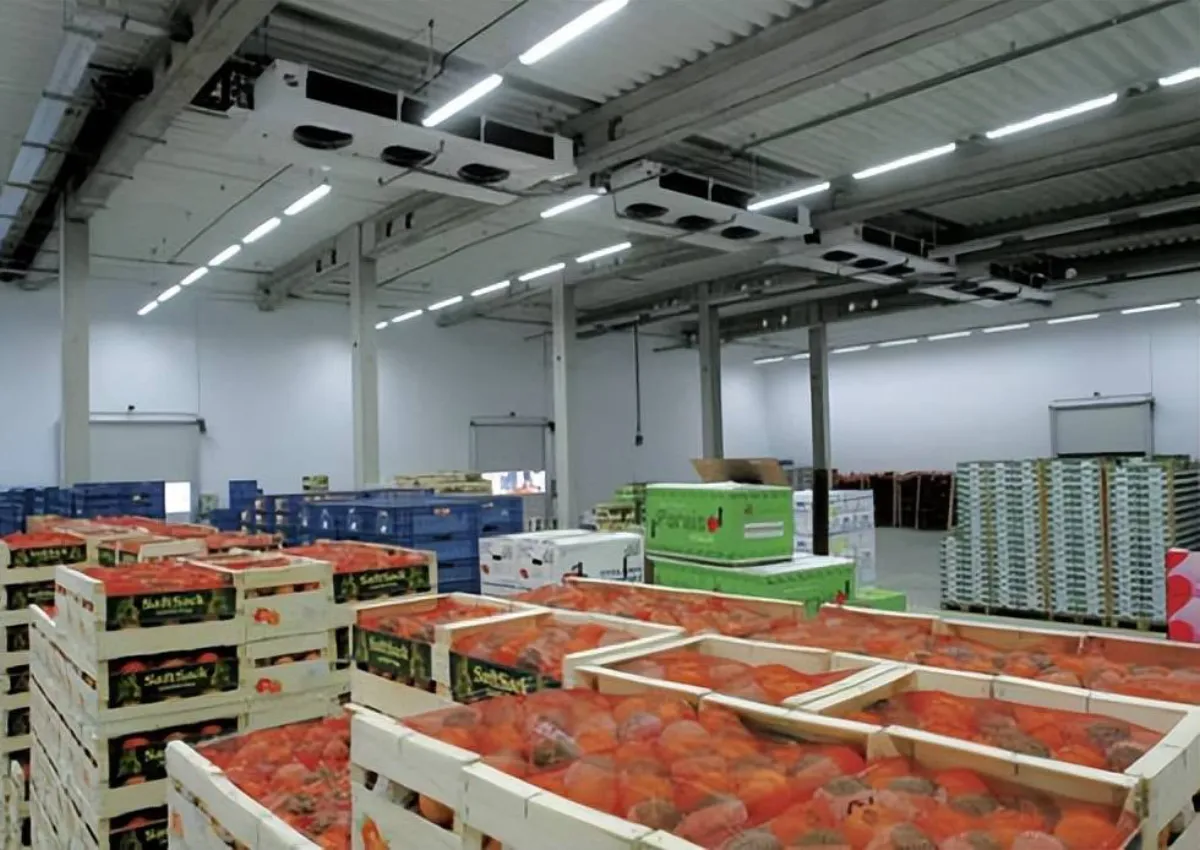
1. Why Cold Storage Fire Protection Is Different
Standard wet-pipe sprinkler systems keep water in the pipes at all times. In a -25°C freezer, that water freezes solid. A frozen pipe doesn’t flow when a fire happens, and the expansion force of freezing water can split steel pipe — creating a flood the moment temperatures rise above freezing.
Cold storage adds three challenges that don’t exist in ambient-temperature warehouses:
1. Temperature extremes. Freezer temperatures range from -18°C (standard food storage) to -40°C (blast freezers, pharmaceutical cold chains). Any water trapped in a pipe, valve, or low-point drain pocket will freeze and block the system.
2. Condensation and ice buildup. Warm, humid air entering a cold storage area during loading condenses instantly. Ice accumulates on sprinkler heads, pipe hangers, and detection devices — potentially obstructing spray patterns or insulating thermal detectors so they don’t respond.
3. Product sensitivity. A cold storage facility holding $2M of frozen seafood or a pharmaceutical company’s entire clinical trial material batch cannot tolerate an accidental sprinkler discharge. The water damage is total, and the business continuity impact is often existential.
NFPA 13 (Standard for the Installation of Sprinkler Systems) addresses these conditions in Chapter 16, “Protection of Miscellaneous Storage and Special Hazards,” and FM Global Property Loss Prevention Data Sheet 8-29 covers refrigerated storage in depth.
2. Dry Pipe Systems: How They Work in Cold Storage
A dry pipe system keeps the sprinkler piping filled with pressurized air or nitrogen instead of water. A dry pipe valve at the riser holds back the water supply. When a fire opens a sprinkler head, air pressure drops, the valve trips, and water floods the piping network.
What makes it suitable for cold storage
The trade-offs
| Concern | Impact in Cold Storage |
|---|---|
| Water delivery delay | Dry pipe systems can take up to 60 seconds to deliver water after head activation, depending on system volume. In a freezer with high-rack storage, that delay means more fire growth before suppression begins. NFPA 13 limits dry pipe system volume to 750 gallons (single) or requires an accelerator/exhauster. |
| Air compressor maintenance | The compressor must run in or near the freezer environment. Cold air intake increases moisture condensation in the compressor, requiring frequent dryer and filter maintenance. |
| Corrosion from condensation | Temperature cycling at loading dock interfaces causes internal condensation in dry pipe. Over years, this corrodes the pipe from the inside — invisible until a leak or trip failure. Nitrogen supervision (instead of compressed air) eliminates this but adds operational cost. |
| False trip risk from ice plugs | If a low-point drain isn’t properly pitched and a small amount of water enters during maintenance, it can freeze into an ice plug that blocks the pipe entirely — not visible, not detectable until fire. |
3. Pre-Action Systems: Adding a Detection Layer
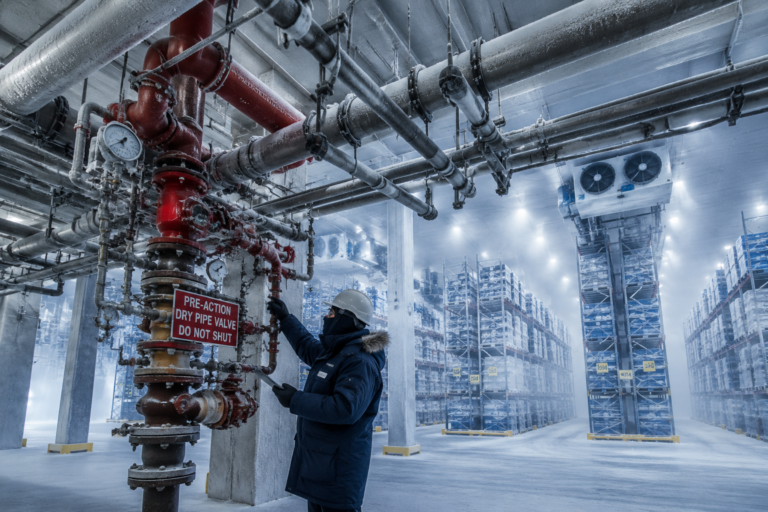
A pre-action system is a dry pipe system with an electrical detection circuit that must also activate before water enters the piping. Think of it as a two-key safe: both the detection system AND a sprinkler head must activate before water flows.
Single-interlock pre-action
The detection system (smoke, heat, or aspirating) triggers and opens the pre-action valve, filling the pipes with water. The sprinkler heads then operate as a standard wet system. A sprinkler head opening without a detection signal does NOT cause water flow.
Advantage over dry pipe: No accidental discharge from a mechanically damaged sprinkler head — a forklift hitting a head in a busy freezer aisle does not flood the facility.
Disadvantage: Still a single point of failure. If the detection system false-trips (dust, forklift exhaust, electrical fault), the pipes fill with water in a -25°C environment. That water will freeze within hours, and the system is now a frozen wet system — completely inoperable until thawed and drained.
Double-interlock pre-action
Both the detection system AND a sprinkler head must activate before the pre-action valve opens. A detection signal alone does nothing. A sprinkler head opening alone does nothing. Both must happen.
This is the preferred configuration for cold storage because it prevents both accidental discharge (sprinkler damage without fire) AND detection false-trip flooding (detection signal without a sprinkler open). The pipes stay dry unless a genuine fire exists.
The trade-off: Water delivery is slower than single-interlock. NFPA 13 addresses this with maximum system volume limits and requirements for accelerators or quick-opening devices on larger systems.
| System Type | Sprinkler Damage → Flood? | Detection False Trip → Flood? | Water Delivery Speed | Complexity |
|---|---|---|---|---|
| Dry Pipe | Yes (when valve trips) | N/A — no detection | Slow (15-60 sec) | Low |
| Single-Interlock Pre-Action | No | Yes | Medium (after detection signal) | Medium |
| Double-Interlock Pre-Action | No | No | Slower (needs both signals) | High |
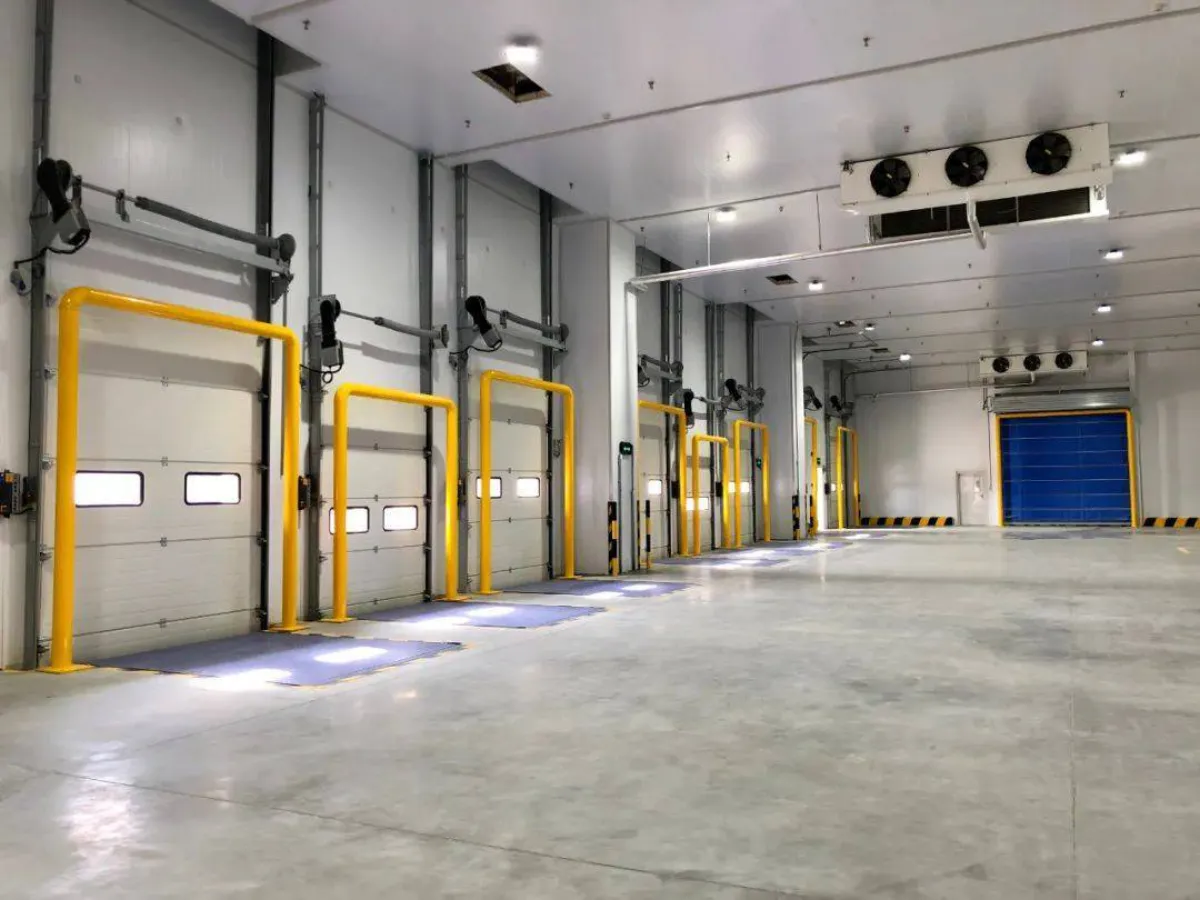
4. NFPA 13 Requirements for Cold Storage (Chapter 16)
NFPA 13 Chapter 16 covers the protection of storage — which includes cold and freezer storage. Key provisions that affect dry pipe and pre-action selection:
System size limits (Section 8.2):
Sprinkler orientation (Section 8.5):
Obstruction rules (Section 8.6):
Heated vestibule requirements (Section 16.3):
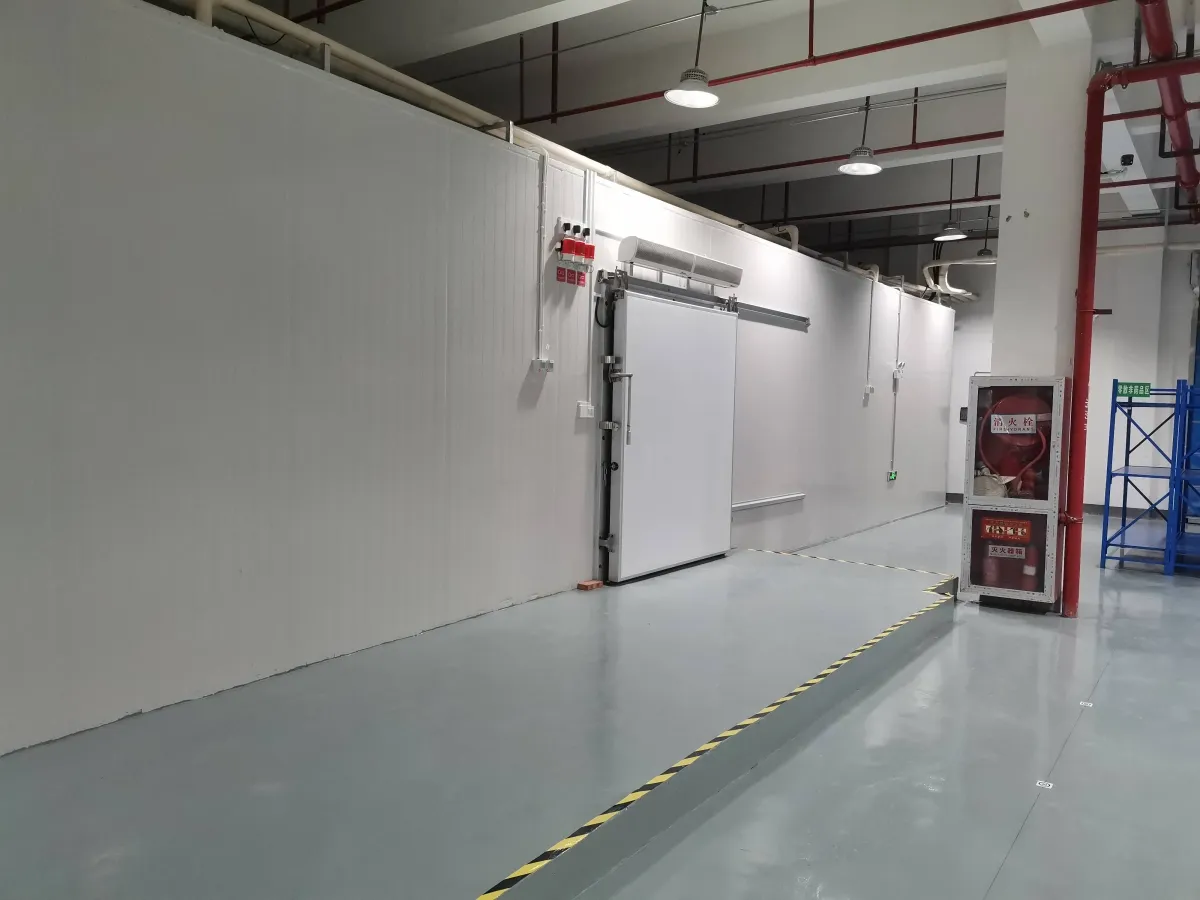
5. Detection: The Overlooked Problem
Detection in a cold storage environment is harder than in a standard warehouse. Three factors work against conventional detectors:
Temperature stratification. Freezer air is dense and still. Hot gases from a fire rise quickly but cool rapidly — forming a stratified layer well above the floor but below the ceiling where detectors are mounted. A ceiling-mounted heat detector may never reach its activation temperature.
Ice fog. Door openings introduce warm, moist air that instantly condenses into a fog of ice crystals. Standard smoke detectors (photoelectric or ionization) see this as smoke. The false alarm rate in busy cold storage facilities can be high enough that operators disconnect the detection system — what happened in several documented cold storage fire losses.
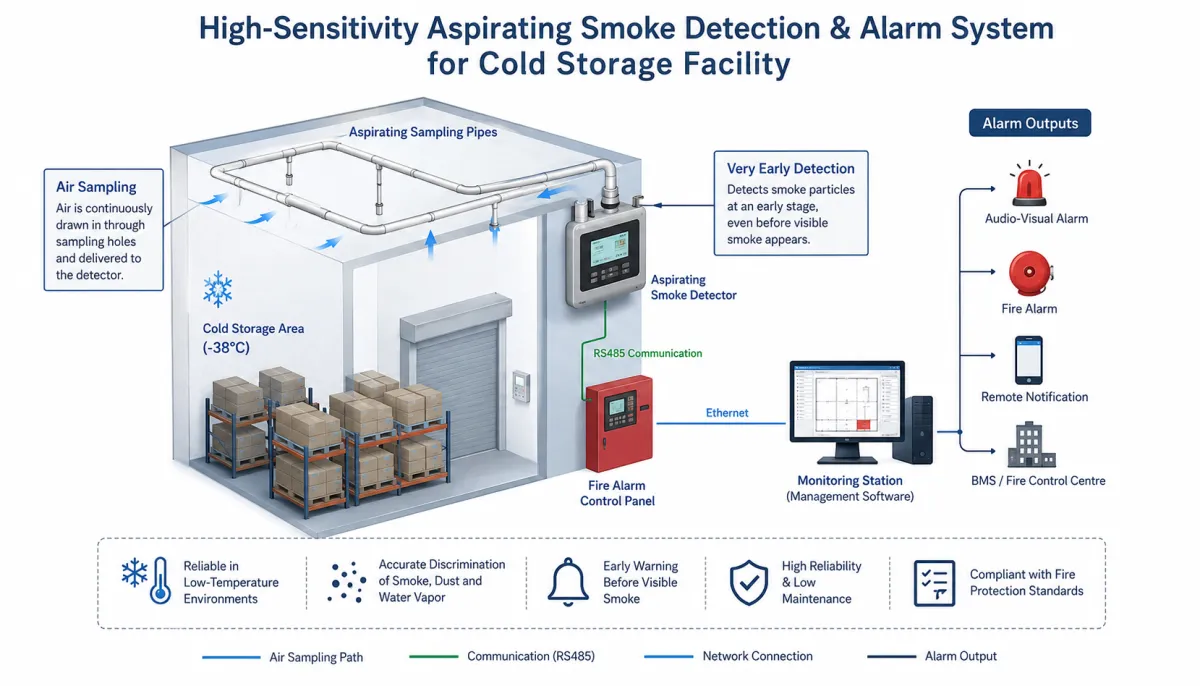
The solution: Aspirating smoke detection (ASD / VESDA).
VESDA (Very Early Smoke Detection Apparatus) continuously draws air samples through a pipe network into a central detection unit in a heated area. The detector analyzes the sample in a controlled temperature/humidity environment. This solves both the stratification and ice fog problems simultaneously.
For double-interlock pre-action in cold storage, VESDA is the standard detection method. It provides:
6. Decision Framework: Dry Pipe vs Pre-Action
When dry pipe is the right choice
A dry pipe system makes sense when all of these are true:
When pre-action is the right choice
Pre-action (preferably double-interlock) is the default when any of the following apply:
Decision table
| Scenario | Recommended System | Reasoning |
|---|---|---|
| Small freezer (< 2,000 m²), commodity storage | Dry pipe with accelerator | Simplicity and cost win; risk of frozen inventory is acceptable |
| Large freezer (> 5,000 m²), commodity storage | Dry pipe, split into multiple zones | Volume per system stays under 750 gal; water delivery time compliant |
| Automated warehouse (AS/RS), any size | Double-interlock pre-action + VESDA | Robot damage to sprinkler head cannot flood the facility; early detection essential |
| Pharmaceutical / high-value cold chain | Double-interlock pre-action + VESDA + nitrogen supervision | Absolute prevention of false discharge; corrosion elimination |
| Blast freezer (-35°C to -40°C) | Double-interlock pre-action with dry-pendent sprinklers | Extreme temperatures make any water incursion catastrophic within minutes |
| Existing wet system being retrofitted | Single-interlock pre-action with glycol anti-freeze loop | Avoids full repipe; glycol loop provides freeze protection at the riser |
Decision engine
IF inventory value > $500/m² AND facility is automated
→ Double-interlock pre-action + VESDA
IF inventory value < $200/m² AND facility is manually operated
→ Dry pipe with accelerator
IF facility operates below -30°C
→ Double-interlock pre-action regardless of inventory value
IF insurance carrier requires pre-action
→ The decision is made for you — comply
7. Cost: The Numbers
Cost data is approximate and varies by geography, but the order-of-magnitude differences guide decision-making:
| Cost Element | Dry Pipe | Single-Interlock Pre-Action | Double-Interlock Pre-Action |
|---|---|---|---|
| Valve/trim cost (per riser) | $3,000–$8,000 | $8,000–$15,000 | $10,000–$20,000 |
| Detection system | Not required | $5–$15/m² (smoke/heat) | $15–$30/m² (VESDA) |
| Air compressor + maintenance | $2,000–$5,000/year | $2,000–$5,000/year | $2,000–$5,000/year |
| Nitrogen system (optional) | $8,000–$15,000 install + $3,000/year | Same | Same |
| Annual inspection cost | $1,500–$3,000 | $3,000–$6,000 | $4,000–$8,000 |
| Pipe replacement (20-year lifecycle) | Full replacement likely (corrosion) | Partial replacement | Minimal (nitrogen) |
| Cost of one false discharge | Inventory loss + downtime | Inventory loss + downtime | Near zero |
The 20-year total cost of ownership difference narrows significantly when you factor in the cost of even one preventable false discharge. For a facility holding $1M+ in inventory, the pre-action premium recovers its cost the first time a forklift hits a sprinkler head.
8. Common Installation Mistakes
Mistake 1: Using standard pendent sprinklers in a dry system. The dry-pendent sprinkler has a seal at the branch line connection and an extended barrel that keeps the water seal in the heated space. A standard pendent in a dry branch line traps water that freezes and cracks the assembly.
Mistake 2: Ignoring pitch requirements. NFPA 13 requires dry pipe branch lines to pitch at least 1/2 inch per 10 feet (4 mm/m) toward a drain point. In a freezer ceiling, getting this pitch right is harder than it sounds — hanger rods must be cut to exact lengths, and thermal contraction of the pipe after installation can reverse the pitch. Condensate then pools at a new low point and freezes.
Mistake 3: Locating the air compressor inside the cold zone. The compressor intakes freezing air, the moisture freezes in the lines, and the system loses pressure. The compressor and air dryer must be in a heated mechanical room with a desiccant or refrigerated dryer upstream of the dry pipe valve.
Mistake 4: Single-interlock pre-action without freeze protection on the valve room. If the detection system false-trips and the pre-action valve opens, water fills the entire pipe network. In a -25°C environment, that water freezes within 2-4 hours. The system is now inoperable and requires draining, thawing, and possibly pipe replacement. Double-interlock prevents this scenario entirely.
FAQ
Q1: Can I convert an existing dry pipe system to pre-action?
Yes, but it requires adding a detection system, replacing the dry pipe valve with a pre-action valve, and adding a releasing panel. The piping network itself can remain. The cost is approximately 60-70% of a new pre-action installation. The practical trigger for conversion is usually an insurance mandate or a near-miss incident.
Q2: Does NFPA 13 allow dry pipe in freezers below -30°C?
Yes, NFPA 13 does not specify a minimum temperature. The constraint is practical: at very low temperatures, any maintenance activity that introduces moisture (opening a pipe joint, testing) becomes high-risk. FM Global 8-29 provides more detailed guidance for extreme cold storage — including requirements for nitrogen supervision below -30°C.
Q3: What happens if a pre-action detection system loses power?
The detection system must be supervised — meaning a power loss or fault triggers a trouble signal at the fire alarm panel. The pre-action valve remains closed. The sprinkler system continues to function as a dry pipe system (sprinkler head opening will trip the valve mechanically in most valve designs). This fail-safe behavior is required by NFPA 72.
Q4: How often should VESDA pipe networks be tested in a freezer?
NFPA 72 requires annual sensitivity testing and quarterly visual inspection of the sampling pipe network. In cold storage, add a semi-annual check for ice blockage at the sampling points — ice can form inside the sampling ports from condensation cycling. A blocked sampling port means no detection for that zone.
Q5: Is a diesel fire pump viable for a cold storage facility?
Only if the pump room is heated and the fuel is winterized. Diesel fuel gels at low temperatures (typically below -10°C for #2 diesel). A cold-start diesel engine at -30°C may not start within the 15-second window required by NFPA 20. Electric pumps with a backup generator are more common for cold storage facilities in extreme climates.
References
Conclusion
Cold storage fire protection is a decision between simplicity (dry pipe) and security (pre-action). The right answer is rarely the cheapest one upfront — it’s the system that protects the business from the cost of being wrong. A dry pipe system that trips from a forklift-damaged head floods $2M of frozen inventory. A pre-action system that false-trips and freezes its own pipes is inoperable when the real fire happens. Double-interlock pre-action with VESDA and nitrogen supervision eliminates both failure modes, and for any facility where inventory value or automation complexity justifies the premium, it is the most common specification.
If You Only Remember One Thing
In cold storage below -30°C or any facility with automated handling systems, specify double-interlock pre-action with VESDA detection. The upfront cost premium disappears the first time you avoid a false discharge.