Why Gas Suppression Is the Standard for Data Centers
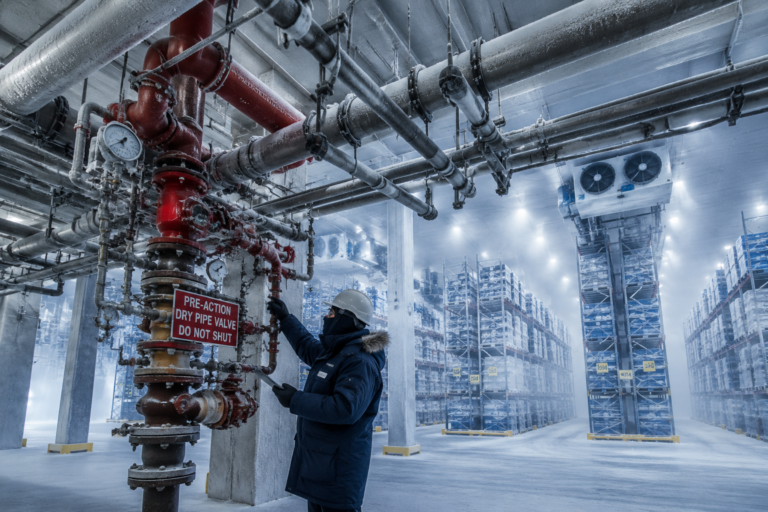
Water-based sprinklers are the default fire protection for most buildings. For data centers, they are the last thing you want. A sprinkler discharge can destroy servers, storage arrays, and network equipment in seconds — not from the fire. From the water.
NFPA 75 recognizes that water-based systems are inappropriate for IT spaces where equipment must be protected from water damage. Gas-based clean agent suppression is the standard response.
Three classes of gaseous suppression exist for data centers:
| Class | Examples | Mechanism | Occupant Safe? | Residue? |
|---|---|---|---|---|
| Clean agent (halocarbon) | HFC-227ea (FM-200), FK-5-1-12 (Novec 1230) | Heat absorption + chemical interruption | Yes | None |
| Clean agent (inert gas) | IG-541 (Inergen), IG-01 (Argon), IG-55 | Oxygen displacement | Yes (breathable at design concentration) | None |
| Carbon dioxide (CO2) | CO2 total flooding | Oxygen displacement to ~15% | ❌ Lethal | None |
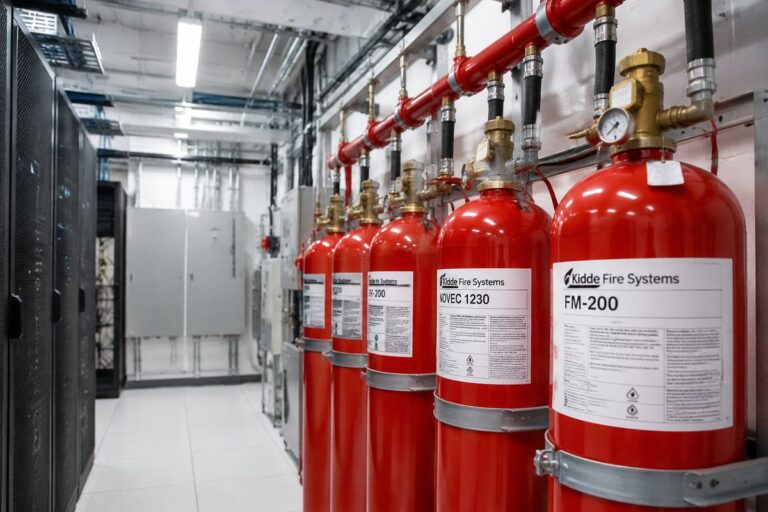
Among these, HFC-227ea — sold commercially as FM-200 — has the largest installed base globally. Fast discharge (under 10 seconds), moderate storage footprint, proven in thousands of data center installations.
HFC-227ea (FM-200): How It Works
Suppression Mechanism
HFC-227ea (heptafluoropropane, chemical formula CF₃CHFCF₃) is stored as a liquefied compressed gas in steel cylinders pressurized with nitrogen to 25 bar (360 psi). Upon discharge, it converts rapidly from liquid to gas, absorbing heat from the fire zone. The primary extinguishing mechanism is heat absorption — the agent cools the flame below its combustion temperature — supplemented by mild chemical interference with the chain reaction of combustion.
At the design concentration of 8–9% by volume (for Class A surface fires), FM-200 achieves extinguishment within 10 seconds of discharge.
Environmental Profile
| Property | Value |
|---|---|
| Ozone Depletion Potential (ODP) | 0 |
| Global Warming Potential (GWP) | 3,350 (100-year) |
| Atmospheric lifetime | ~31 years |
| Regulatory status | Approved under SNAP (US); permitted for new installations through 2036 with phase-down |
FM-200’s GWP of 3,350 is why some operators are moving to Novec 1230 (GWP=1) or inert gas. But its installed base is large enough that replacement will take decades, not years.
Compliance Standards
- NFPA 2001 — Standard on Clean Agent Fire Extinguishing Systems (design, installation, inspection, testing)
- NFPA 72 — National Fire Alarm and Signaling Code (detection and actuation)
- ISO 14520 — Gaseous Fire-Extinguishing Systems (international equivalent)
- UL 2166 — Standard for High-Pressure Carbon Dioxide Fire Extinguishing System Units (applicable to cylinder construction)
- FM Approval 5600 / CE 0404 — Equipment certification
System Design: Key Engineering Parameters
3.1 Agent Quantity and Design Concentration
The NFPA 2001-required design concentration for HFC-227ea depends on the fire hazard:
| Hazard Class | Min. Design Conc. | Example Application |
|---|---|---|
| Class A (ordinary combustibles) | 8.0% v/v | Server rooms, offices |
| Class B (flammable liquids) | 8.7% v/v | Fuel storage, generator rooms |
| Class C (energized electrical) | 8.0% v/v | UPS rooms, switchgear |
The flooding factor (mass of agent per unit volume) is calculated using the specific volume of the agent vapor at the maximum anticipated temperature in the protected space. A typical calculation for a 100m³ data center room at 21°C requires approximately 70–80 kg of FM-200, depending on enclosure leakage.
3.2 Nozzle Layout and Pipe Network
Nozzle placement is not uniform. Each nozzle covers a defined area of coverage (typically 6–8m radius at ceiling height), and the pipe network must be hydraulically balanced so that every nozzle receives the correct flow rate. Key rules:
- Nozzles must be positioned to avoid obstructions (overhead cable trays, light fixtures, HVAC diffusers)
- Pipe network must be symmetrical — branch imbalance of more than 15% flow will cause one zone to under-discharge
- Discharge time must not exceed 10 seconds for total flooding systems (NFPA 2001, Section 5.2)
- Follow manufacturer nozzle flow curves (e.g., Chemetron, Kidde, or Fike orifice data) — generic hydraulic calculations are not acceptable
3.3 Detection and Actuation Sequence
A standard clean agent release sequence follows this timeline:
T+0s   Smoke detected by VESDA or spot-type detector (alarm)
T+30s  Cross-zone confirmation from second detector (pre-discharge alarm)
T+45s  Abort timer window (personnel can hold release from inside)
T+55s  HVAC shutdown + damper closure + ventilation isolation
T+60s  Solenoid valve opens → agent discharges from cylinders
T+70s  Full agent concentration achieved throughout enclosure
The 60-second delay gives personnel time to evacuate — or abort the release for a false alarm.
3.4 Enclosure Integrity
Enclosure integrity is where systems most often fail. A clean agent system can be perfectly calculated and still fail because the room leaks faster than the agent can be held at design concentration.
NFPA 2001 requires the protected enclosure to hold the design concentration for a minimum of 10 minutes (hold time). Verification is done via:
- Door fan test (positive pressure) — measures leakage area in m² @50Pa
- Concentration analysis — real-time oxygen/agent sensors during discharge test
- Sealing of uncloseable openings — cable penetration seals, duct gaps, door undercuts
A leak rate of 1% of the room volume per minute is generally acceptable. Above 2%, enclosure sealing is required before the system can be commissioned.
Comparison: HFC-227ea vs Novec 1230 vs IG-541
| Dimension | FM-200 (HFC-227ea) | Novec 1230 (FK-5-1-12) | IG-541 (Inergen) |
|---|---|---|---|
| Storage | Liquid @ 25 bar | Liquid @ 24 bar | Compressed gas @ 200+ bar |
| GWP | 3,350 | 1 | 0 |
| Design concentration | 8–9% | 4–6% | 35–42% |
| Discharge time | <10 sec | <10 sec | <60 sec |
| Storage footprint | Medium | Medium | Large (4–5× more cylinders) |
| Personnel safety | Safe | Safe | Safe (breathing possible) |
| Maintenance | Semi-annual weighing | Semi-annual weighing | Semi-annual pressure check |
| Annual OOS | $2,000–5,000+ | $2,500–6,000+ | $1,500–3,000 |
When HFC-227ea wins: limited floor space for cylinder storage, need for fast discharge, existing system replacement without redesign
When Novec 1230 wins: corporate ESG/sustainability mandate, need for lowest GWP, new construction where enclosure is designed from scratch
When IG-541 wins: unlimited storage space, lowest environmental concern, preference for naturally occurring gas (no synthetic chemistry)
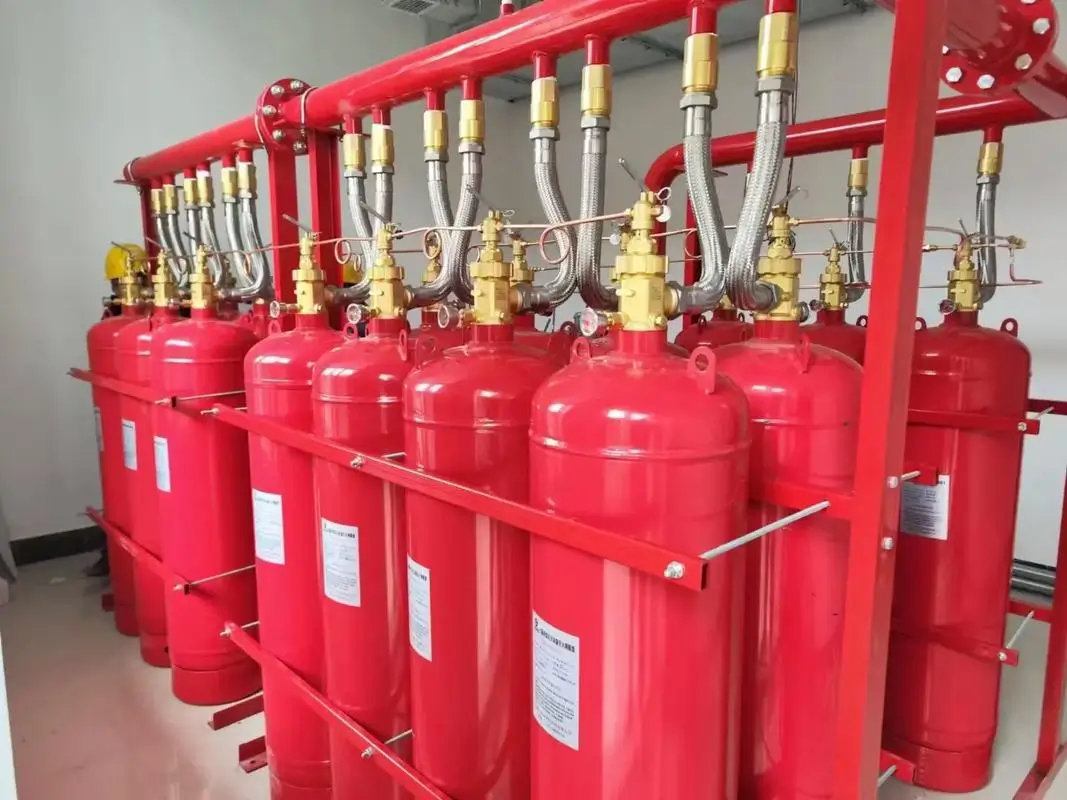
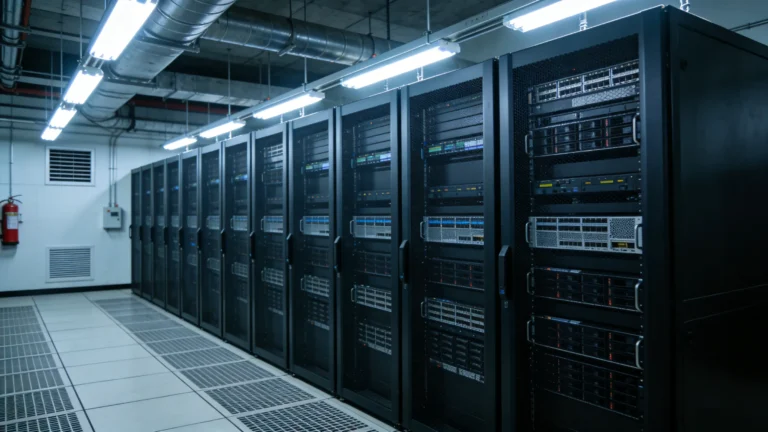
Case Walkthrough: Smart Control Data Center
Omnifir completed a comprehensive HFC-227ea gas suppression system for a smart control data center, covering approximately 450m² of server room and control room area.
Project Parameters
- Protected volume: ~1,350 m³ (450m² × 3m ceiling height)
- Agent type: HFC-227ea (FM-200)
- Design concentration: 8.3% v/v (Class A + C)
- Total agent mass: 1,085 kg
- Cylinder configuration: 12 × 90 kg cylinders, 25 bar
- Nozzles: 28 ceiling-mounted, radial discharge
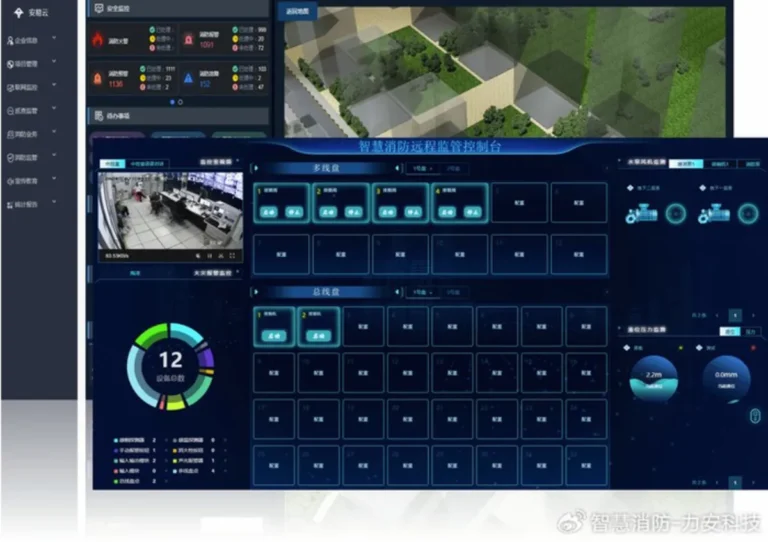
- Detection: VESDA aspirating system + dual-zoned spot detectors (cross-zone)
- Discharge time: 9.2 seconds (measured)
- Hold time: 12 minutes @ design concentration (verified by fan door test)
Key Installation Details
The pipe network was modeled using hydraulic calculation software per NFPA 2001 Annex C, with three independent branch zones for server room, UPS room, and control room. Each zone has its own solenoid valve and selector valve assembly, allowing selective discharge without draining all cylinders.
Enclosure sealing was a significant effort: 37 cable penetration points through fire-rated walls were sealed with intumescent putty, and two overhead cable tray gaps were closed with fire stop pillows.
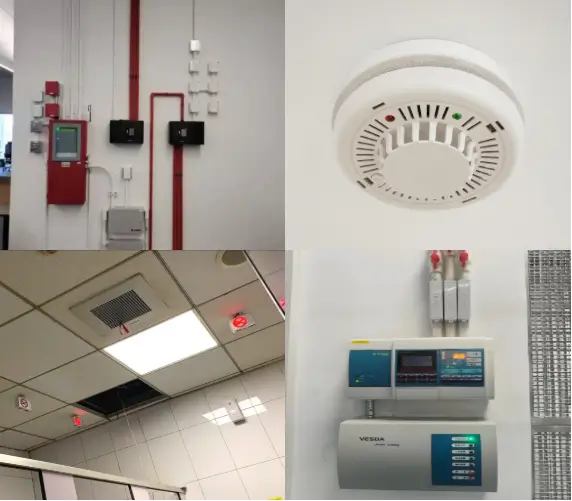
See our full data center fire protection approach. Cost Breakdown
| Component | Typical Cost | Notes |
|---|---|---|
| HFC-227ea agent (per kg) | $40–60/kg | Price fluctuates with raw material availability |
| Cylinders (90 kg, 25 bar) | $2,500–4,000 each | UL listed, includes valve and pressure gauge |
| Nozzles + pipe network | $3,000–8,000 | Depends on nozzle count and pipe routing complexity |
| Detection + control panel | $4,000–8,000 | VESDA adds $2,000–5,000 premium over spot detection |
| Installation labor | $8,000–18,000 | Varies by accessibility and local labor rates |
| Enclosure sealing | $1,500–4,000 | Door fan test + sealing materials |
| Total installed (typical) | $15,000–50,000 | 100–400m² protected area |
Annual maintenance: $800–2,000 per year, including: – Semi-annual cylinder weighing (verify agent mass within ±5% of marked charge) – Semi-annual inspection of detection system sensitivity – Annual discharge nozzle check (no obstructions, correct orientation) – Annual enclosure integrity walk-through
Not Ideal When
Budget is constrained. Clean agent systems carry the highest upfront cost among fire suppression options. A dry pipe sprinkler system costs approximately one-quarter of an equivalent clean agent installation. If the equipment value in the space does not justify clean agent protection, consider pre-action sprinkler as a middle-ground alternative.
Enclosure integrity is poor and cannot be improved. A room with permanent openings to outdoors, overhead doors, or ventilation systems that cannot be interlocked will leak agent faster than the system can maintain concentration. In these cases, local application systems (direct nozzle discharge at specific equipment) or inert gas with higher design concentration may compensate — but the designer must accept higher agent usage.
Your organization has committed to GWP reduction. HFC-227ea has a GWP of 3,350. If your company reports on sustainability or follows the Kigali Amendment timelines, Novec 1230 (GWP=1) or inert gas (GWP=0) are better choices.
Decision Engine: Which Clean Agent to Choose
If you have a standard server room (50–200m²) and need lowest installed cost → Choose HFC-227ea (FM-200). It offers the most cost-effective pathway for small-to-medium rooms with moderate floor space for cylinders.
If your organization has a net-zero commitment → Choose Novec 1230. Its GWP of 1 eliminates the concern, same discharge speed and storage footprint.
If the protected space is very large (>1,000m²) and you have no floor-space constraints → Choose IG-541 (Inergen). It is the most environmentally benign option and provides breathable atmosphere during discharge, which simplifies personnel safety planning.
If you operate in multiple jurisdictions requiring different certifications → Choose a single-supplier multi-certification system (UL + FM + CE + MED as required). Omnifir provides clean agent systems certified to NFPA 2001, UL 2166, and CE 0404, with supporting documentation for local regulatory acceptance across North America, Europe, and Asia.
FAQ
Is FM-200 (HFC-227ea) safe for occupied data center spaces?
Yes, at the design concentration of 8–9% by volume, FM-200 is safe for occupied spaces. NFPA 2001 permits clean agent concentrations up to the No Observable Adverse Effect Level (NOAEL), which for HFC-227ea is 10.5%. The 8–9% design concentration provides an adequate safety margin. Pre-discharge alarms and time delay (typically 30–60 seconds) allow personnel to evacuate before discharge.
How often should an HFC-227ea system be inspected?
Semi-annual: cylinder weighing and visual inspection of all nozzles, piping, and detection devices. Annual: full system function test (solenoid activation, alarm panel testing, enclosure integrity walk-through). NFPA 2001, NFPA 72, and local AHJ requirements should all be consulted for minimum intervals.
What is the difference between clean agent and CO2 suppression for data centers?
CO2 is lethal at fire-suppressing concentrations (~34% by volume) and is rapidly being phased out of occupied spaces globally. Clean agents (HFC-227ea, Novec 1230, inert gases) are designed to suppress fire at concentrations that allow safe human occupancy. CO2 should never be used for total flooding of a data center — it is suitable only for unoccupied machinery spaces per NFPA 12.
Does FM-200 damage server equipment?
No. FM-200 leaves no residue, is electrically non-conductive, and does not cause thermal shock. Servers, UPS systems, and storage equipment can continue operation during and after discharge. This is the core advantage of clean agent over water-based suppression in IT environments.
- NFPA 2001 — Standard on Clean Agent Fire Extinguishing Systems — Primary standard governing design, installation, testing, and maintenance of HFC-227ea systems.
- NFPA 75 — Standard for the Protection of Information Technology Equipment — Standard that defines fire protection requirements for data centers and server rooms.
- FM-200 Engineering and Installation Manual (Chemetron/Kidde) — Manufacturer-level design guidance including nozzle flow curves, pipe network calculation methods, and enclosure integrity testing protocols.
- US EPA SNAP Program — HFC-227ea Regulatory Status — Latest regulatory status for HFC-227ea under the Significant New Alternatives Policy.
- ISO 14520 — Gaseous Fire-Extinguishing Systems — International design standard for gaseous fire suppression systems (equivalent to NFPA 2001 for international projects).
- FM Approvals 5600 — Clean Agent Fire Extinguishing System Equipment — Equipment certification requirements for FM-approved clean agent systems.
- NIST — Clean Agent Fire Suppression Research — Technical research on agent effectiveness, discharge modeling, and enclosure integrity.
If You Only Remember One Thing
HFC-227ea (FM-200) is the 10-second, no-residue, occupied-space-safe standard for data center fire suppression — but if your organization has a GWP target, design for Novec 1230 instead from the start. Retrofitting is more expensive than choosing right the first time.