Key Takeaways
1. What Is a Kitchen Hood Fire Suppression System?
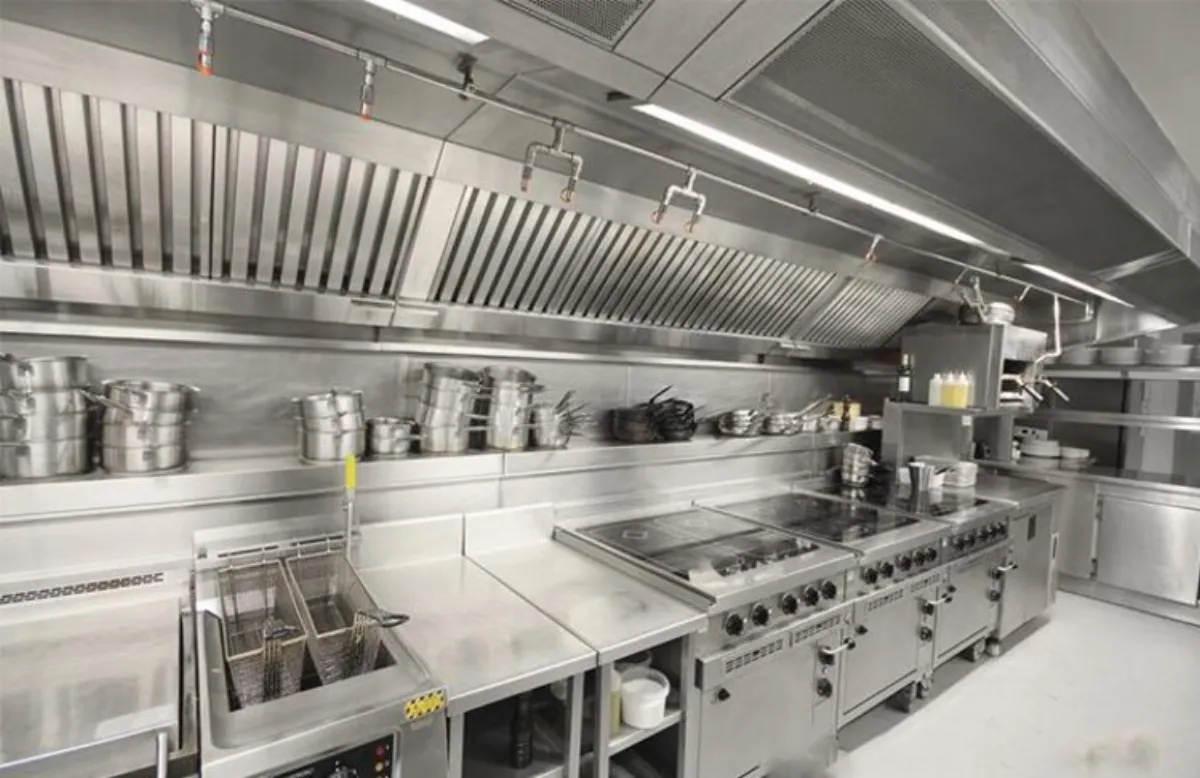
A kitchen hood fire suppression system is a pre-engineered, automatically activated fire extinguishing system built into a commercial kitchen’s exhaust hood, ductwork, and cooking appliance area. Unlike a portable extinguisher hanging on the wall, this system is hard-piped, tied to the fuel shutoff, and designed to discharge without any human intervention the moment a fire is detected above the cooking line. For broader facility protection, see our guides on fire suppression system types and data center gas suppression.
The system protects four zones simultaneously:
NFPA 17A (Standard for Wet Chemical Extinguishing Systems) governs every aspect — from which appliances need a nozzle to how often the chemical tanks must be hydrostatically tested. UL 300 (Fire Testing of Fire Extinguishing Systems for Protection of Commercial Cooking Equipment) is the testing standard that manufacturers must pass to get a UL label on their system. Together they define what “protected” means for a commercial kitchen.
2. NFPA 17A: The Governing Standard
NFPA 17A is not a product standard. It is a system standard — it tells you how to install, inspect, test, and maintain a pre-engineered wet chemical system so that it works when fire happens.
**Key requirements under Chapter 5:**
| Requirement | What It Means |
|---|---|
| Simultaneous operation | Every nozzle, on every appliance and every hood served by the same system, must discharge together. One fire triggers full coverage. |
| Automatic fuel/power shutoff | Gas valves and electric breakers feeding cooking equipment must trip automatically when the system activates (Section 4.4.1). |
| Manual actuation | A mechanical pull station must be present even if the system has automatic detection. No electricity needed to pull it. |
| Alarm interconnection | If the building has a fire alarm system, kitchen suppression activation must trigger it. |
| Monitoring | Electrically dependent systems must have supervisory circuits that alert when power or functionality is lost. |
**Chapter 7 — Inspection & Maintenance** breaks responsibility into two tiers:
| Tier | Who | Frequency | What |
|---|---|---|---|
| Owner’s inspection | Kitchen operator | Monthly | Visual check: tamper seals intact, nozzles unobstructed, pressure gauge in green, no appliance changes |
| Professional service | Licensed contractor | Semi-annual (every 6 months) | Full component exam: detectors, piping, agent quantity, nozzle caps, linkage, fuel shutoff, test discharge simulation |
| Hydrostatic test | Licensed contractor | Every 12 years | Agent cylinders, auxiliary pressure cylinders, and hose assemblies tested to design pressure for ≥30 seconds |
Any deficiency found during any inspection must be corrected immediately. There is no grace period — the standard treats an impaired system as equivalent to no system.
3. UL 300: Why It Changed Everything
Before 1994, commercial kitchen suppression systems used dry chemical agents (sodium bicarbonate or potassium bicarbonate based). Dry chemical works by interrupting the chemical chain reaction of combustion — it puts the fire out fast. But it does almost nothing to cool the hot cooking surface.
This became a critical failure mode when restaurants switched from animal fats to vegetable oils. Vegetable oils have higher auto-ignition temperatures and better heat retention in modern insulated deep fryers. A dry chemical system would extinguish the flame, then the hot oil would re-ignite the vapors seconds later. The fire was out, then it was back — sometimes bigger than before.
**UL 300 (1994) mandated a fundamental shift:**
| Feature | Dry Chemical (Pre-UL 300) | Wet Chemical (UL 300 Compliant) |
|---|---|---|
| Extinguishing mechanism | Chain reaction interruption only | Saponification + vapor sealing + cooling |
| Re-ignition risk | High — no cooling effect | Low — agent forms a soapy blanket that seals and cools |
| Application | Nozzles in hood/duct only | Nozzles over every individual appliance + hood/duct |
| Agent residue | Fine powder, corrosive to electronics | Foam-like layer, easier to clean |
| Fuel shutoff | Not always integrated | Mandatory automatic shutoff |
Today, NFPA 96 (Ventilation Control) and most state fire codes reference UL 300 as mandatory. Insurance carriers routinely require UL 300-listed systems as a condition of coverage. A kitchen running a pre-1994 dry chemical system is, functionally, uninsured.
4. How Wet Chemical Works
Wet chemical agents (typically potassium acetate, potassium carbonate, or potassium citrate solutions) extinguish cooking oil fires through two simultaneous mechanisms:
**1. Saponification.** When the agent contacts hot oil, a chemical reaction produces a thick layer of soap (saponification literally means “soap-making”). This soap layer floats on the oil surface, sealing off oxygen and preventing flammable vapor release.
**2. Cooling.** The water content in the wet chemical solution absorbs heat and cools the oil surface below its auto-ignition temperature. The combination of sealing + cooling is what prevents re-ignition — the problem that made dry chemical obsolete.
Discharge is typically under 30 seconds for the entire system. The agent exits nozzles as a fine spray, not a solid stream, to maximize surface coverage.
A UL 300-compliant system is tested against actual cooking appliances with burning vegetable oil at 350°C+ to verify it can extinguish the fire AND keep it out for a minimum observation period after discharge.
5. System Components — What’s in the Box
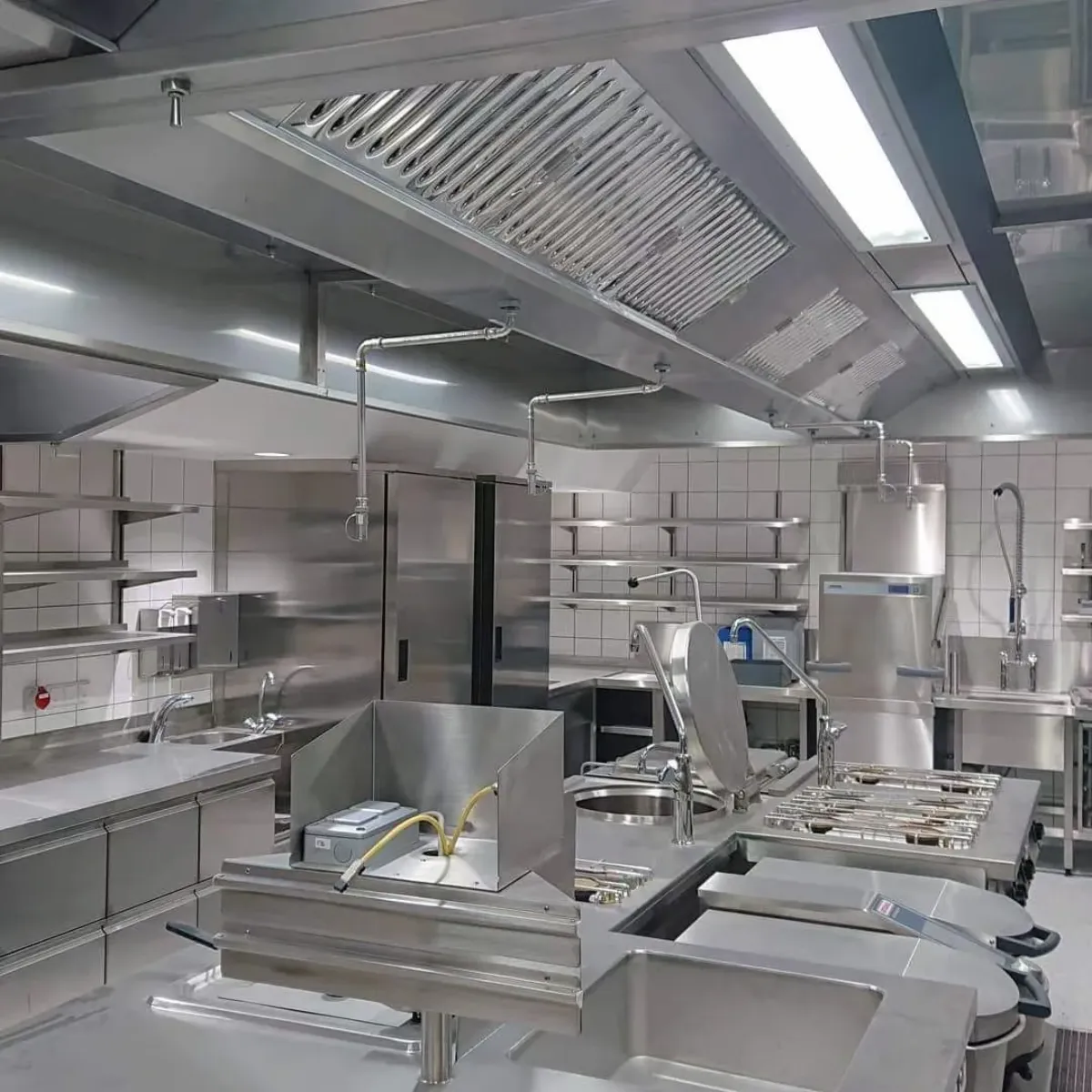
A typical commercial kitchen suppression system includes:
| Component | Function |
|---|---|
| **Agent storage cylinder** | Stainless steel tank holding the wet chemical under nitrogen pressure. Sized per the number and type of appliances protected. |
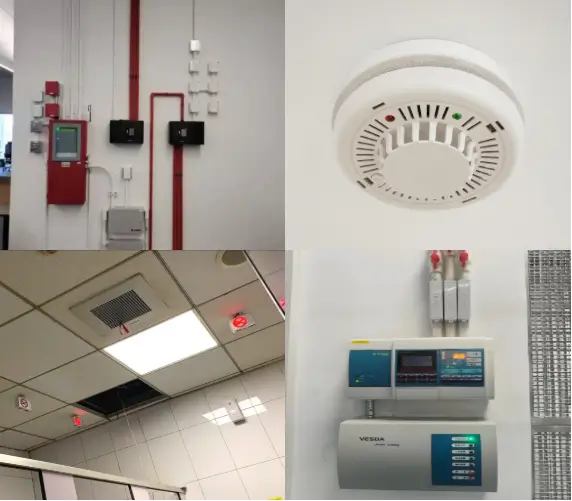
| **Detection network** | Fusible links or pneumatic detection tubing mounted in the hood and over each appliance. When heat melts a link, the system discharges. |
| **Distribution piping** | Stainless steel or chrome-plated pipe network carrying agent from the cylinder to each nozzle. |
| **Discharge nozzles** | Pre-sized orifices positioned over each appliance, inside the hood plenum, and in the duct. Each nozzle has a factory-calibrated flow rate. |
| **Manual pull station** | Mechanical cable-actuated handle, typically mounted on the hood or wall near the exit path. Works without electricity. |
| **Gas valve / contactor** | Automatic fuel shutoff device. For gas appliances, a mechanical valve in the gas line. For electric, a shunt-trip breaker or contactor. |
| **Microswitch / pressure switch** | Sends a signal to the building fire alarm panel and/or building management system upon discharge. |
| **Blow-off caps** | Plastic caps on nozzle orifices to prevent grease intrusion. Designed to pop off under discharge pressure. |
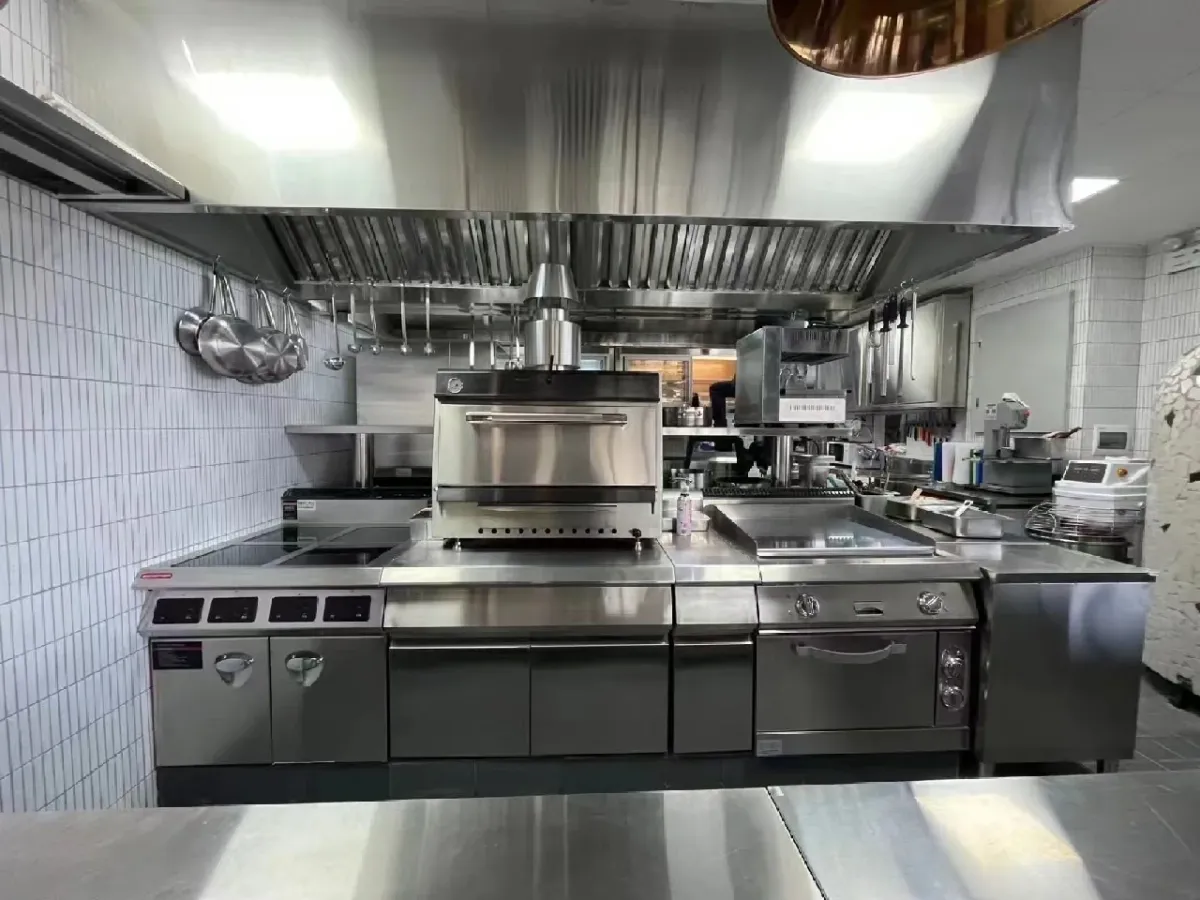
The system is “pre-engineered” — meaning the manufacturer has already calculated flow rates and nozzle sizes. The installer’s job is to place nozzles according to the manufacturer’s listed coverage diagram, not to design the hydraulics from scratch.
6. What Must Be Protected
NFPA 17A and UL 300 require a nozzle over every individual grease-producing cooking appliance. This specifically includes:
Non-grease-producing equipment (steamers, combi ovens without browning function, pasta cookers, rice cookers) may not require coverage — but the AHJ (Authority Having Jurisdiction) is the final decision-maker.
If you add or move an appliance, the system must be re-evaluated. The standard is clear: the system protects a specific layout. Change the layout, and the protection is void until re-certified.
7. Installation & Compliance Workflow
1. **Submit plans** to the local AHJ (fire marshal or building department). Drawings must show every appliance, hood boundary, nozzle location, cylinder placement, and fuel shutoff device.
2. **Install per manufacturer’s listed design.** Deviation from the UL-listed configuration voids the listing.
3. **Commissioning test** — verify all detection links, discharge through every nozzle (using test gas or actual agent), confirm fuel shutoff trip, confirm alarm signal.
4. **Tag and certify** — a metal tag on the cylinder shows the install date, service company, and next service due date.
5. **Train kitchen staff** — staff must know where the manual pull station is, what happens when the system discharges, and the evacuation procedure.
8. Inspection Schedule at a Glance
| Frequency | Action | Who |
|---|---|---|
| **Monthly** | Visual check: tamper seals, pressure gauge, nozzle caps, no appliance changes | Kitchen owner/manager |
| **Semi-annual** | Full inspection: all components, agent quantity, linkage, fuel shutoff, discharge simulation | Licensed fire protection contractor |
| **After activation** | Full recharge + inspection. Discard used agent; re-pressurize cylinder | Contractor |
| **12 years** | Hydrostatic test: agent cylinder, auxiliary cylinders, hose assemblies | Contractor with test equipment |
| **When appliances change** | System re-evaluation: nozzle count, agent quantity, coverage verification | Contractor |
Documentation is not optional. Every inspection must generate a written report kept on file and available for the AHJ and insurance auditor. The metal service tag on the cylinder is a summary — the written report is the legal record.
9. Cost Overview (2025-2026 Estimates)
| Item | Typical Range |
|---|---|
| New system installation (single hood, ≤5 appliances) | $4,000 – $8,000 |
| New system installation (large kitchen, multiple hoods) | $8,000 – $15,000 |
| Semi-annual inspection + service visit | $250 – $600 per visit |
| Recharge after discharge | $800 – $2,500 (agent + labor) |
| Hydrostatic test (12-year) | $500 – $1,200 |
| Upgrade from dry chemical to UL 300 wet chemical | $3,500 – $7,000 |
The largest variable is the number of appliances and the distance from the cylinder to the farthest nozzle — more appliances require a larger cylinder and more piping.
10. Compliance Checklist for Kitchen Operators
11. Decision Table: Choosing the Right Setup
| Scenario | Recommendation |
|---|---|
| New restaurant build, single cooking line | Standard UL 300 pre-engineered system from Amerex, Ansul, or Range Guard |
| Large kitchen with multiple islands and hoods | Zoned system with separate cylinders per hood or a networked system |
| Kitchen with electric-only appliances | Same UL 300 wet chemical — fuel shutoff uses shunt-trip breakers instead of gas valves |
| Renovating a kitchen with existing dry chemical | Full replacement. Partial upgrades are not UL-listed and will not meet code. |
| Kitchen with a solid-fuel appliance (wood/charcoal) | Additional coverage may be required — consult manufacturer’s listing |
| High-ceiling kitchen (>15 ft) | Verify nozzle coverage height in the manufacturer’s UL listing |
12. Decision Engine
13. FAQ
Does a small cafe with only a panini press need a suppression system?
If there is no grease-laden vapor production, the AHJ may not require one. But any deep fryer, griddle, or open-flame cooking triggers the requirement. When in doubt, ask your local fire marshal.
Can I clean the nozzles myself?
No. Nozzle blow-off caps are factory-installed and calibrated. Cleaning, replacement, or adjustment must be done by a licensed contractor during the semi-annual service.
What happens if someone pulls the manual station by accident?
The system discharges. There is no “cancel” button — it is a one-shot mechanical release. The kitchen shuts down, the agent discharges, and you must call a contractor for recharge. Train staff accordingly.
Is fire suppression the same as a fire extinguisher?
No. A Class K portable extinguisher is a supplement, not a substitute. The hood suppression system is the primary line of defense. Both are required.
How long does a properly maintained system last?
Indefinitely — as long as cylinders pass hydrostatic testing, agent is replaced on schedule, and components are inspected. There is no mandatory retirement age for the system itself, only the 12-year test cycle.
1. NFPA 17A — Standard for Wet Chemical Extinguishing Systems (2017 Edition) — https://www.nfpa.org/17a
2. UL 300 — Fire Testing of Fire Extinguishing Systems for Protection of Commercial Cooking Equipment — https://www.ul.com
3. Koorsen Fire & Security — “Understanding the UL 300 Kitchen Fire Suppression System Requirements in NFPA 17A” — https://blog.koorsen.com
4. Impact Fire Services — “UL 300 Fire Suppression Standard: Why Restaurants Need to Upgrade Now” — https://resources.impactfireservices.com
5. NFPA 96 — Standard for Ventilation Control and Fire Protection of Commercial Cooking Operations — https://www.nfpa.org/96
6. Amerex — Kitchen Protection Brochure (Wet Chemical Systems) — https://www.amerex-fire.com
7. KitchenGuide101 — Kitchen Hood Fire Suppression System Cost (2026) — https://kitchenguide101.com
15. Conclusion
Kitchen hood fire suppression is a code-mandated, insurance-required life safety system. NFPA 17A covers the rules; UL 300 certifies the equipment. For sites needing whole-facility coverage, see our fire protection system solutions. The technology settled decades ago on wet chemical for a reason: it is the only agent class that can seal, cool, and suppress a modern vegetable-oil kitchen fire in one discharge. Compliance is not complex, but it is continuous — monthly, semi-annually, and every 12 years. The owner carries the legal obligation, not the contractor.
If You Only Remember One Thing
A UL 300-listed wet chemical system with a current semi-annual service tag is the single most important piece of fire protection equipment in your commercial kitchen — if your tag is out of date, your system is effectively not there.