Cold Storage Fire Protection at -38°C: Engineering & Compliance Guide
Key Takeaways
Standard wet-pipe sprinkler systems fail at sub-zero temperatures because water freezes in pipes, causing blockages and burst lines
Dry-pipe and pre-action sprinkler systems are the primary solutions, each with distinct trade-offs in response speed vs water damage prevention
Aspirating Smoke Detection (VESDA/ASD) is the recommended detection method for -38°C environments due to its immunity to condensation and false alarms from frost
Fluid delivery time compliance (NFPA 13 Section 8.2.3.4) is the single most critical hydraulic design constraint in cold storage sprinkler systems
The Viking ESFR pre-primed preaction (propylene glycol) and Tyco Quell ceiling-only systems represent the current state-of-the-art for automated cold storage suppression
1. Why Standard Fire Protection Fails in Sub-Zero Environments
The chemical equation for fire — fuel + oxygen + heat — operates just as well at -38°C as it does at room temperature. Cold storage facilities contain enormous fuel loads: wooden pallets, corrugated cardboard, plastic shrink wrap, polystyrene packaging, and combustible insulation panels (polyurethane/PIR). A Johnson Controls analysis notes that “once ignited, these materials can burn rapidly, producing high heat release rates and toxic smoke” even in sub-zero conditions.
However, the fire protection systems designed for normal buildings break down in three fundamental ways:
Frozen piping. Wet-pipe sprinkler systems keep water constantly pressurized in the pipes. At -38°C, that water freezes solid, blocking flow. When ice expands, it ruptures pipes, valves, and fittings — potentially disabling the entire system and requiring costly disassembly and thawing to restore service.
Detector condensation and frost. Standard smoke detectors rely on optical or ionization chambers that are easily fooled by frost, condensation, and ice crystals — all of which are constantly present in a -38°C freezer environment. False alarms become routine, and real fires can go undetected when condensation patterns mask genuine smoke particles.
Sprinkler head icing. Even if the piping network stays dry (as in dry-pipe systems), sprinkler heads exposed to extreme cold can accumulate ice that physically blocks the heat-sensitive element from activating properly, or delays activation until the fire has already grown beyond control.
These three failure modes mean that a conventional off-the-shelf fire protection design is not just suboptimal at -38°C — it is dangerous.
2. Key Engineering Challenges at -38°C
Designing a fire protection system for a -38°C cold storage facility requires addressing six interconnected challenges:
Challenge
Impact
Severity
Pipe freezing
Complete system disablement; burst pipes require full disassembly to repair
Critical
Condensation in detection
False alarms → desensitization → missed real fires
Critical
Sprinkler head icing
Delayed activation → fire grows beyond suppression capacity
High
Thermal stratification
Hot smoke from fire stays near ceiling; sensors at breathing height detect nothing
Moderate
Corrosion from humidity cycling
Dry-pipe systems corrode 3-5× faster than wet due to condensation inside pipes
High
Access for maintenance
Frozen walkways, ice on ladders, limited personnel time inside -38°C
Moderate
The most difficult of these is the condensation-detection paradox: the colder the environment, the more moisture condenses on any surface that is even slightly warmer than ambient — and detector housings, even when designed for cold environments, are precisely those slightly-warm surfaces. This is why traditional spot-type smoke detectors are not suitable for direct installation inside -38°C freezer chambers without heated housings or external sampling tubing.
3. System Design: Dry-Pipe vs Pre-Action Sprinkler Selection
NFPA 13 (2022 edition, Section 16.4.1.1) is unequivocal: “Where any portion of a system is subject to freezing and the temperatures cannot be reliably maintained at or above 40°F (4°C), the system shall be installed as a dry pipe or preaction system.”
Dry-Pipe Systems
How it works: Pipes are filled with compressed air or nitrogen at approximately 40 psi. Water is held back at a dry-pipe valve located in a heated space. When a sprinkler activates, air pressure drops, the valve opens, and water flows into the pipes and out the open sprinkler.
Cons: Inherent water delivery delay (NFPA 13 limits to 60 seconds for most hazard classifications); higher internal corrosion rate; larger system volume increases delivery time; ice formation from trapped residual moisture.
Pre-Action Systems
How it works: Pipes remain dry until a separate fire detection system (smoke/heat) confirms a fire and signals the pre-action valve to open. Only then does water enter the pipes. Individual sprinkler heads still require thermal activation to discharge.
Sub-types:
– Single interlock: Detection opens valve → water enters pipes → sprinkler head activation discharges water
– Double interlock: Both detection AND sprinkler activation required before water enters pipes
Pros: Virtually eliminates accidental water discharge (double interlock); faster water delivery than dry-pipe since pipes are pre-charged before sprinkler activation; better for water-sensitive goods.
Cons: Higher installation and maintenance cost; more complex control logic; requires reliable detection system as pre-condition.
Comparison Table
Parameter
Dry-Pipe
Single Interlock Pre-Action
Double Interlock Pre-Action
Water in pipes
Never (until activation)
After detection confirms
Only after both detection + sprinkler activation
Water delivery delay
15-60 seconds
5-15 seconds (pipes pre-charged)
10-20 seconds
Accidental discharge risk
Low
Moderate (if detection falsely triggers)
Very low
Relative cost (1x baseline)
1.0x
1.3-1.5x
1.5-2.0x
Best for
Small to medium freezers, budget-constrained
Large cold storage, food warehouses
High-value goods, pharmaceutical cold chain
NFPA 13 design path
Prescriptive (Ch. 8, 16)
Performance-based or prescriptive
Performance-based
Corrosion rate relative to wet pipe
3-5× higher
2-3× higher
2-3× higher
Advanced: ESFR Pre-Primed Preaction Systems (Viking/Tyco)
The current engineering frontier for cold storage is the pre-primed preaction system, used in Viking’s ESFR Cold Storage System and Tyco’s Quell platform. These systems fill sprinkler piping with a propylene glycol/water solution that remains liquid at -38°C and below (50% propylene glycol freezes at -32.2°C, with specialized formulations reaching -45°C). When fire is detected:
Detection signals the deluge valve to open
The glycol/water solution is discharged at design pressure
Water from the supply system follows, pushing out the glycol solution
Within seconds, 100% water flows from sprinklers
The advantage is no water delivery delay — pipes are already charged with liquid, so suppression begins immediately. The glycol solution is food-grade (propylene glycol) and poses minimal contamination risk. Johnson Controls’ Tyco Quell systems have been FM Approved for ceiling-only protection up to 50-55 feet, eliminating the need for in-rack sprinklers entirely.
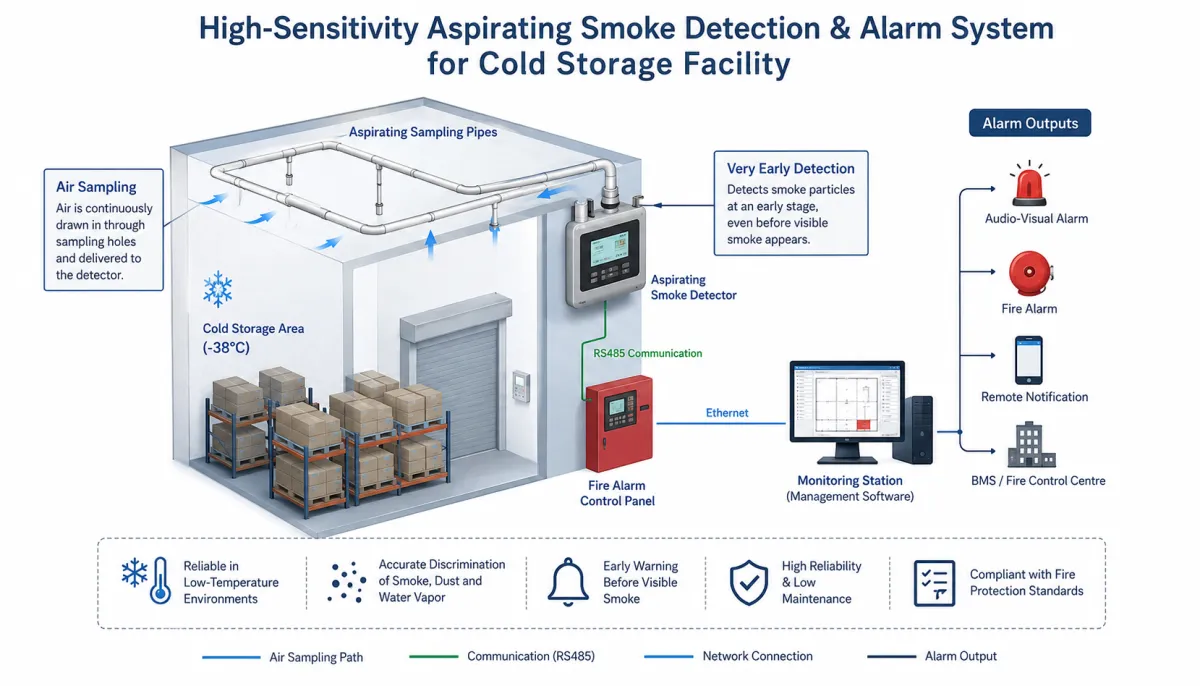
For -38°C environments, aspirating smoke detection (ASD) — commonly known by the brand name VESDA — is the detection method of choice. The Omnifir cold storage case study at a 17,307m² food R&D and production facility successfully deployed ASD with the following advantages:
How ASD works: A network of sampling tubes with small holes is routed through the cold space. A high-efficiency aspirator (vacuum pump) draws air samples continuously back to a centralized detector unit located in a heated area (equipment room or control panel). The detector analyzes air for smoke particles using a laser-based chamber.
Why ASD is superior at -38°C:
Detection unit is outside the cold zone. The sensitive optics and electronics stay in a temperature-controlled environment. Only the sampling tubes enter the freezer.
Immune to condensation and frost. Air is drawn through tubes at high velocity; moisture either stays suspended or condenses inside the tube where it does not interfere with the laser detection chamber. The detector sees the air sample at room temperature.
Multi-level alarm thresholds. ASD detectors support Alert → Action → Fire 1 → Fire 2 stages, allowing pre-emptive response before visible smoke.
Early warning at incipient stage. ASD can detect a fire at the “pre-combustion” particle stage — minutes before a traditional spot detector would respond.
False alarm resistance. The laser chamber distinguishes smoke particles from dust, water vapor, and ice crystals using particle-size analysis. This is critical in cold storage where forklift exhaust, frost dislodged by defrost cycles, and condensation are constant background noise.
Not ideal when: The facility is very small (<500m² single-chamber freezer) and the cost of ASD ($3,000-$8,000 per detector zone) cannot be justified; in such cases, heated-base spot detectors or rate-of-rise heat detectors in combination with dry-pipe sprinklers may be adequate.
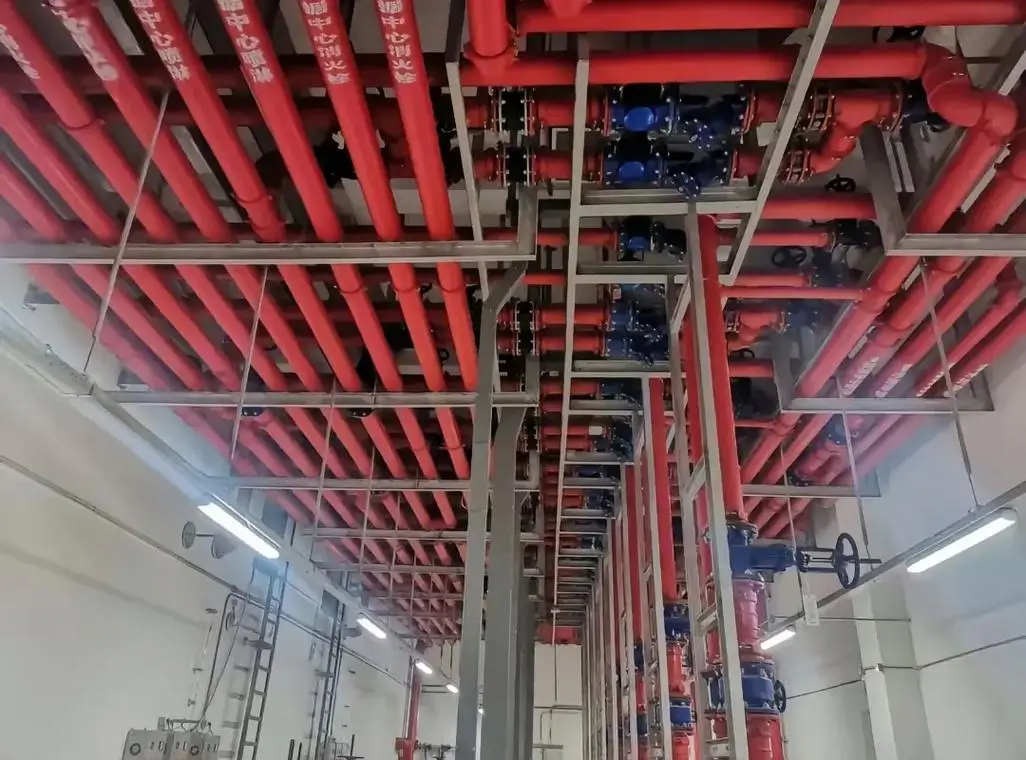
5. Fire Pump Room Design
for Freezing Conditions
The pump room is the heart of any fire suppression system, and in cold storage applications, its design requires special attention:
Location requirements:
– Pump room must be in a heated area, maintained at minimum 4°C (40°F) per NFPA 20
– Ideally located immediately adjacent to the cold storage chamber wall to minimize pipe run length
– Separate HVAC zone with backup heating and temperature monitoring
Key design considerations:
– Electric fire pumps are preferred over diesel in cold climates (diesel fuel can gel at low ambient temperatures; battery reliability degrades)
– Piping from pump room to cold zone must pass through a heated chase with insulation rated for the temperature differential
– Valve assemblies (dry-pipe valve, pre-action valve, backflow preventer) all located in the heated pump room
– Air compressor for dry-pipe/pre-action systems must be fitted with a dryer to minimize moisture entering the piping network
– Standby power is non-negotiable: if the utility power fails and the pump cannot run, the entire fire protection scheme is compromised
6. Case Walkthrough: 17,307m
² Food R&D & Production Cold Storage Facility
Project profile:
Parameter
Value
Total area
17,307.34 m²
Temperature
-38°C (freezer), 0-4°C (refrigerator)
Application
Food R&D, production, and processing
Location
China
The challenge: Standard wet-pipe sprinklers and spot-type smoke detectors would fail completely at -38°C. The facility required a system that could operate reliably in extreme cold, high moisture, and condensation-prone conditions — while meeting both Chinese (GB 50084) and international (NFPA 13) standards.
The Omnifir solution:
Detection: Full ASD (aspirating smoke detection) system with sampling tubes routed through all freezer and refrigerator chambers. The central detector unit sits in a temperature-controlled equipment room. Multi-level alarm thresholds allow pre-emptive response.
Suppression: Pre-action sprinkler system (double interlock) with dry-pipe valve assembly located in the heated pump room. Piping in the cold zone is pressurized with nitrogen (not compressed air) to minimize internal corrosion.
Installation methodology: The team used a “no-open, no-fill” construction technique — pipes pass through insulated walls via sealed sleeves with no penetrations that would allow cold air leakage. This:
Prevented cold air loss and maintained refrigeration efficiency
Reduced installation complexity by approximately 30%
Eliminated condensation-related maintenance at wall penetrations
Pump room: Electric fire pump with backup generator, located in a dedicated heated space adjacent to the freezer wall. Piping from the pump room to the cold zone runs through an insulated heated chase.
Outcome: The system achieved full compliance with GB 50084 and NFPA 13, with estimated 30% reduction in installation cost compared to conventional approaches requiring extensive heated enclosures within the cold zone.
7. Regulatory Compliance Framework
Cold storage fire protection must satisfy multiple overlapping standards. The key requirements by jurisdiction:
Standard
Relevant Section
Key Requirement
NFPA 13 (2022)
16.4.1.1
Dry-pipe or pre-action required when temp < 4°C
NFPA 13 (2022)
8.2.3.4
Fluid delivery time ≤ 60 seconds (dry-pipe)
NFPA 13 (2022)
Annex E
Calculation methods for water delivery time
NFPA 20
Ch. 9
Fire pump room minimum temp 4°C
NFPA 72
17.17.2.2.2
Air pressure monitoring for dry-pipe systems
NFPA 25
Ch. 5, 13
ITM requirements for dry-pipe/pre-action systems
GB 50084
Ch. 4
Sprinkler system design for cold storage
GB 50072
Ch. 7
Cold storage construction fire protection
GB 50116
Ch. 6
Fire alarm system design for special environments
FM Global 8-29
Sec. 2.3
Cold storage fire protection recommendations
IBC / IFC
Ch. 9
Automatic sprinkler requirements for storage occupancies
Fluid delivery time is the single most frequently failed compliance metric in cold storage sprinkler design. NFPA 13 requires that water reaches the remote operating sprinkler within 60 seconds for dry-pipe systems in storage occupancies. Designers must perform hydraulic calculations per Annex E, accounting for:
– System volume (pipe length × diameter)
– Air pressure and nitrogen backpressure
– Valve trip time (dry-pipe valve mechanical response)
– Friction losses in the dry-pipe network
If calculated delivery time exceeds 60 seconds, the designer must either: (a) split the system into smaller zones, (b) switch to pre-action with faster valve response, (c) increase pipe diameter to reduce friction, or (d) use an accelerator/exhauster on the dry-pipe valve.
8. Maintenance Protocols for Sub-Zero Fire Systems
Cold storage fire protection systems require more rigorous inspection, testing, and maintenance (ITM) than equivalent systems in normal-temperature buildings. NFPA 25 provides the baseline, with additional considerations for sub-zero environments:
Weekly checks:
– Air pressure on dry-pipe/pre-action systems (NFPA 25 Table 5.1) — verify within 10 psi of nominal
– Low-temperature alarms in pump room and valve enclosure
– Visual inspection of piping for ice accumulation at hangers and supports
Monthly checks:
– Test air compressor dryer function and drain moisture traps
– Verify ASD aspirator flow rate (should be within 15% of acceptance test baseline)
– Check sampling tube orifices for ice blockage in freezer zones
Quarterly checks:
– Full flow test of dry-pipe valve (trip test) — verify trip time and water delivery
– Inspect sprinkler heads for ice buildup on heat-sensitive elements
– Test emergency generator under load
Annual checks:
– Full internal inspection of dry-pipe valve (NFPA 25 Section 5.3.1.1.1)
– ASD detector cleaning and laser chamber calibration
– Hydrostatic testing of agent cylinders (for clean-agent systems in adjacent spaces)
– Corrosion assessment: cut and inspect a pipe section from representative locations
Critical alert: Nitrogen-filled dry-pipe systems corrode significantly slower than air-filled systems (no oxygen = no oxidation). If your design currently specifies compressed air, consider retrofitting to nitrogen at the next scheduled valve inspection — the corrosion reduction alone often justifies the conversion cost within 3-5 years.
Decision Engine: If X → Choose Y
If your cold storage is small (<2,000 m²) and budget is the primary constraint → Choose a standard dry-pipe system with compressed air. Keep it simple. Just verify fluid delivery time compliance.
If you store food products and cannot risk glycol/antifreeze contamination → Choose double-interlock pre-action without pre-primed lines. Detection-triggered water fill prevents accidental discharge.
If your rack storage height exceeds 40 feet → Choose an ESFR pre-primed preaction system (Viking or Tyco Quell). Ceiling-only protection at this height requires the faster response of a pre-charged system.
If false alarm tolerance is near-zero (pharmaceutical, data, high-value goods) → Choose ASD detection + double-interlock pre-action. Two independent confirmations before any water moves.
If you are retrofitting an existing cold storage with limited budget → Choose ASD detection upgrade first (affects detection, not suppression), then plan dry-pipe → pre-action conversion over 2-3 capital cycles.
If your local code authority requires GB standards compliance → Choose a pre-action system designed per GB 50084 with ASD detection per GB 50116. Coordinate with AHJ early in design to avoid rework.
FAQ
Can I use wet-pipe sprinklers in a cold storage if I insulate the pipes?
Can I use wet-pipe sprinklers in a cold storage if I insulate the pipes?
No. Insulation slows heat transfer but does not prevent freezing at -38°C. NFPA 13 does not recognize insulation or heat tracing as substitutes for dry-pipe or pre-action systems.
What is the minimum temperature for a dry-pipe valve room?
What is the minimum temperature for a dry-pipe valve room?
Per NFPA 20 and NFPA 13, the valve room must be maintained at minimum 4°C (40°F). Below this temperature, priming water in dry-pipe valves can freeze and mechanical components may fail.
How often should ASD sampling tubes be cleaned in cold storage?
How often should ASD sampling tubes be cleaned in cold storage?
Flush sampling tubes annually as a minimum. For facilities with frequent defrost cycles or ammonia refrigeration, increase to semi-annual cleaning.
Does FM Global have specific cold storage requirements beyond NFPA 13?
Does FM Global have specific cold storage requirements beyond NFPA 13?
Yes. FM Global Data Sheet 8-29 provides additional requirements including specific sprinkler density and restrictions on certain plastic commodities.
What is the expected lifespan of a dry-pipe system in cold storage?
What is the expected lifespan of a dry-pipe system in cold storage?
Without nitrogen conversion, expect 15-20 years before internal corrosion requires pipe replacement. With nitrogen, 25-35 years is achievable.
References
Related resources:See ourCold Storage (-38°C) Fire System Optimization Case Studyand theCold Storage Dry Pipe vs Pre-Action Systemsguide.
NFPA 13: Standard for the Installation of Sprinkler Systems, 2022 Edition — Chapter 16: Dry Pipe Systems, Annex E: Water Delivery Time Calculations
NFPA 25: Standard for the Inspection, Testing, and Maintenance of Water-Based Fire Protection Systems, 2023 Edition — Chapter 5: Dry Pipe Systems
Johnson Controls. “Keep Your Assets Frozen: Why You Need the Right Cold Storage Fire Protection.” Building Insights, 2026. — https://www.johnsoncontrols.com/building-insights/2026/thought-leadership/keep-your-assets-frozen
Viking Corporation. “ESFR Cold Storage System Technical Data.” Form No. 033004, 2021. — https://www.vikinggroupinc.com/databook/Old/oldPdf/033004f.pdf
J.F. Ahern. “Fire Sprinkler Protection in Cold Storage Facilities: Why Fluid Delivery Time Matters.” 2025. — https://www.jfahern.com/blog/2025/09/25/fire-sprinkler-protection-cold-storage-facilities-why-fluid-delivery-time-matters
Omnifir. “Cold Storage (-38°C) Fire System Optimization Case Study.” — https://omnifir.com/cold-storage-fire-system-optimization-case-study/
GB 50084-2017: Code of Design for Sprinkler Systems (China)
GB 50072-2021: Code for Design of Cold Storage (China)
FM Global Data Sheet 8-29: Cold Storage Facilities
QRFS. “A Guide to Dry Sprinkler Systems: System Overview.” — https://blog.qrfs.com/143-a-guide-to-dry-sprinkler-systems-part-1/
Conclusion
Cold storage fire protection at -38°C demands a fundamentally different engineering approach than normal-temperature buildings. The three pillars — dry-pipe/pre-action suppression, aspirating smoke detection, and rigorous fluid delivery time compliance — form a system that can reliably protect facilities even in the most extreme freezer environments. The Omnifir 17,307m² case study demonstrates that with proper system selection, detection placement, and installation methodology (including the “no-open, no-fill” approach), compliance with both international (NFPA) and Chinese (GB) standards is achievable at a cost that can undercut traditional approaches by 30% or more.
If You Only Remember One Thing
A -38°C cold storage needs three things: a pre-action or dry-pipe sprinkler system (never wet-pipe), aspirating smoke detection with the detector outside the cold zone, and verified fluid delivery time under 60 seconds — anything less is a gamble with both the facility and the products inside it.
Need a Cold Storage Fire Protection System?
Get a customized engineering design and quotation for your -38°C freezer facility. Our team specializes in NFPA and GB-compliant cold storage fire protection systems.
Key Takeaways — Clean agents are gaseous fire extinguishing agents that leave no residue, are electrically non-conductive, and are safe for occupied spaces at design concentrations. Unlike water sprinklers (which destroy servers) or CO2 (which…
Key Takeaways Hotel fire safety compliance requires coordination across at least seven NFPA codes or their GB equivalents — this guide consolidates them into a single actionable checklist. The most common violations in hotel properties…
Key Takeaways 1. What Is a Kitchen Hood Fire Suppression System? A kitchen hood fire suppression system is a pre-engineered, automatically activated fire extinguishing system built into a commercial kitchen’s exhaust hood, ductwork, and cooking…
Key Takeaways A smart fire protection cloud platform transforms hotel fire safety from reactive alarm-response to proactive risk prevention using IoT sensors, edge computing, and AI analytics The three-layer “Terminal + Edge + Cloud” architecture…
Why Gas Suppression Is the Standard for Data Centers Water-based sprinklers are the default fire protection for most buildings. For data centers, they are the last thing you want. A sprinkler discharge can destroy servers,…
Why Choosing the Right Fire Suppression System Matters Choosing the wrong type for your environment can mean equipment damage, regulatory fines, or worse — system failure during an actual fire. Each system type is engineered…
To provide the best experiences, we use technologies like cookies to store and/or access device information. Consenting to these technologies will allow us to process data such as browsing behavior or unique IDs on this site. Not consenting or withdrawing consent, may adversely affect certain features and functions.
Functional
Always active
The technical storage or access is strictly necessary for the legitimate purpose of enabling the use of a specific service explicitly requested by the subscriber or user, or for the sole purpose of carrying out the transmission of a communication over an electronic communications network.
Preferences
The technical storage or access is necessary for the legitimate purpose of storing preferences that are not requested by the subscriber or user.
Statistics
The technical storage or access that is used exclusively for statistical purposes.The technical storage or access that is used exclusively for anonymous statistical purposes. Without a subpoena, voluntary compliance on the part of your Internet Service Provider, or additional records from a third party, information stored or retrieved for this purpose alone cannot usually be used to identify you.
Marketing
The technical storage or access is required to create user profiles to send advertising, or to track the user on a website or across several websites for similar marketing purposes.