A smart fire protection cloud platform transforms hotel fire safety from reactive alarm-response to proactive risk prevention using IoT sensors, edge computing, and AI analytics
The three-layer “Terminal + Edge + Cloud” architecture ensures continuous operation even when public networks are disrupted — a critical requirement for 24/7 hotel operations
Dual-objective optimization models can reduce total hotel energy consumption by 8-12% while maintaining maximum safety during fire events
Deployment options range from full greenfield installation to retrofitting existing fire alarm panels (compatible with 50+ manufacturers)
Payback period is typically 2-3 years through combined savings in energy costs, insurance premiums, compliance penalties, and maintenance reduction
1. Why Hotels Need a Cloud-Based Fire Monitoring Platform
Hotels present a uniquely challenging fire safety environment: high occupant density, 24/7 operations, diverse facility types (guest rooms, restaurants, kitchens, ballrooms, swimming pools, parking), and high turnover of transient guests unfamiliar with evacuation routes. Traditional standalone fire alarm systems fall short in four critical areas:
Reactive, not proactive. Conventional systems only alert after a fire has already started. By the time the alarm sounds, the fire may have already grown beyond the incipient stage. A smart platform uses continuous sensor monitoring and AI pattern recognition to detect pre-fire conditions — circuit overloads, gradual temperature rises, sensor degradation — days or weeks before an actual fire event.
No centralized visibility. In a large hotel complex spanning 30+ floors and multiple buildings, the fire control room only sees alarms from its own panel. General managers and regional safety directors have no real-time visibility into system status across their portfolio.
Manual compliance burden. Hotels must maintain inspection logs, test records, and audit trails for regulatory compliance (NFPA 101, local fire codes). Manual documentation takes 15-20 hours per month for a mid-size hotel and is prone to gaps that can result in fines or closure orders.
Energy inefficiency. Fire pumps, pressurization fans, and standby systems operate continuously regardless of occupancy or actual risk level. Without intelligent load management, these systems consume significant electricity 24/7.
A smart fire protection cloud platform addresses all four gaps through an integrated IoT-AI architecture.
2. Core Architecture: Terminal + Edge + Cloud
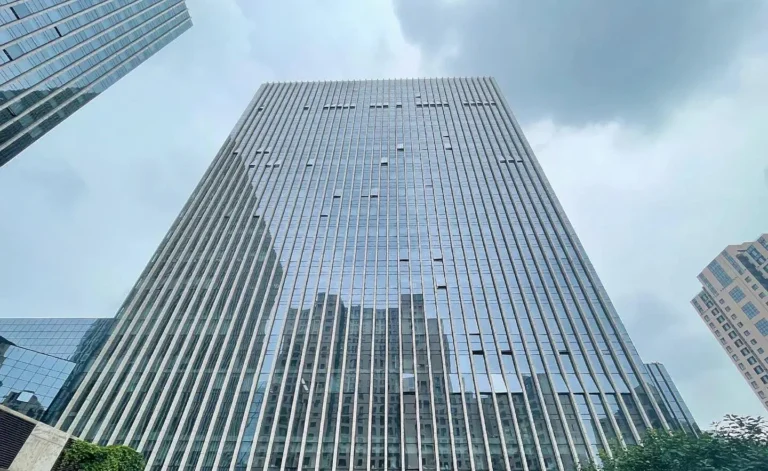
The Omnifir smart fire protection platform, deployed at a 131,760 m² 5-star hotel and commercial complex (33 floors, 166m height), uses a three-layer distributed architecture:
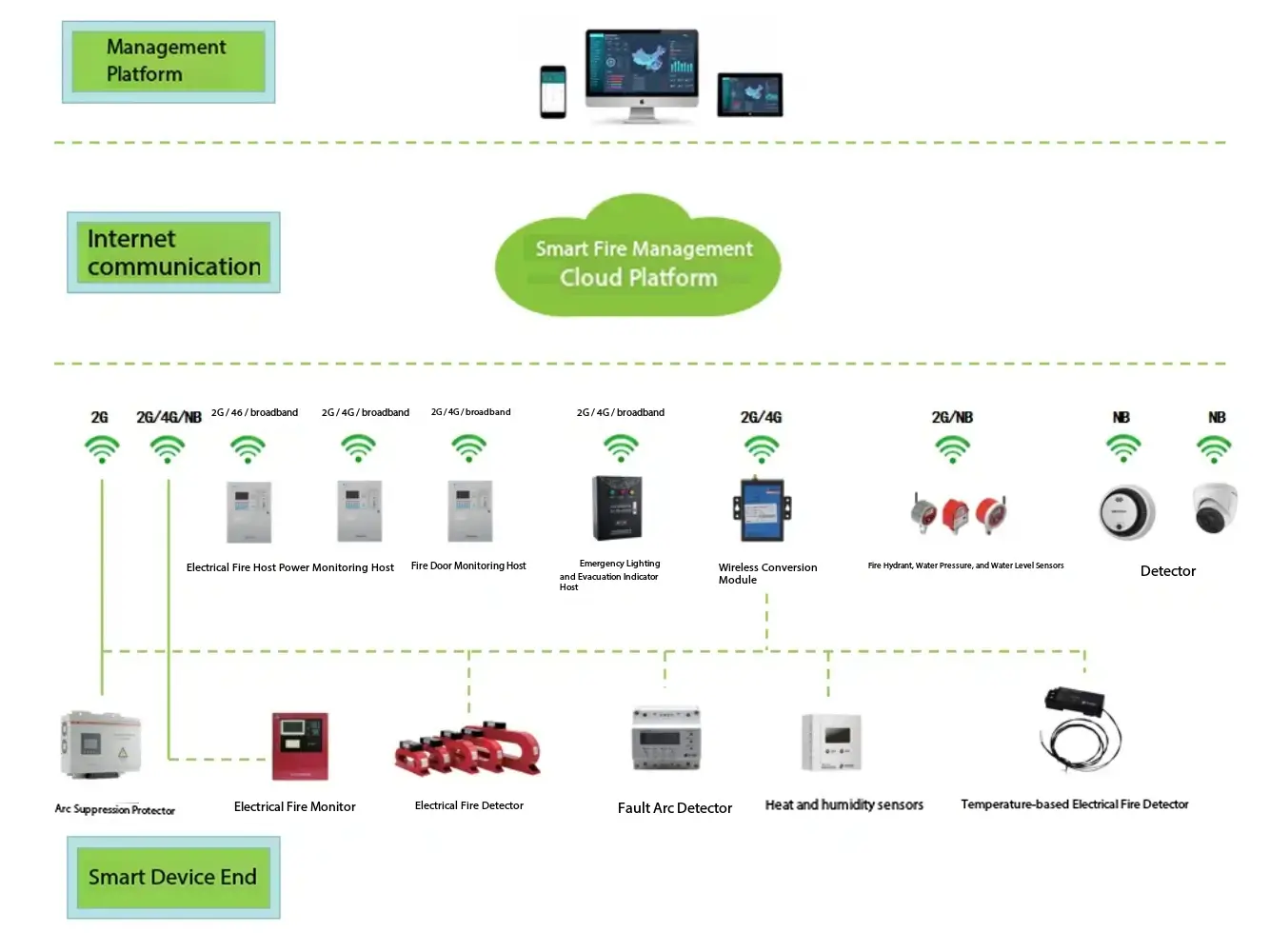
Terminal Layer: Multi-Source Intelligent Sensing
The foundation is a dense network of IoT sensors that go beyond traditional smoke and heat detectors:
Sensor Type
What It Monitors
Why It Matters for Hotels
Addressable smoke/heat detectors
Fire signatures per zone
Pinpoints exact room/location, not just zone
Water flow and pressure sensors
Sprinkler system readiness
Detects leaks, valve closures, pressure drops
Electrical monitoring sensors
Circuit temperature, current, leakage
Prevents electrical fires (leading cause in hotels)
Tank level sensors
Water supply reserves
Ensures sprinkler water supply is adequate
Pump status sensors
Fire pump operational state
Remote verification without physical inspection
Duct smoke detectors
HVAC smoke propagation
Triggers smoke control and HVAC shutdown
Edge Layer: 5G + NB-IoT Local Network
The edge layer is the most critical architectural decision for hotel deployments. Unlike residential buildings, hotels cannot tolerate system downtime during public network outages. Omnifir’s design relies on:
5G and NB-IoT for primary communication between sensors and edge gateways
Local processing at edge nodes so that alarm logic, signal routing, and critical alerts continue functioning even when the cloud connection is lost
Battery-backed edge gateways with 72-hour standby for power outage scenarios
This ensures that critical alarm signals are never interrupted — even if the public internet is down or local infrastructure is damaged — a requirement that directly addresses the fire safety vulnerability window during overnight hours when 60-70% of hotel fires occur.
Cloud Layer: BIM + Real-Time Digital Twin
At the cloud level, Building Information Modeling (BIM) is integrated with live IoT data streams to create a real-time digital twin of the entire hotel fire safety system:
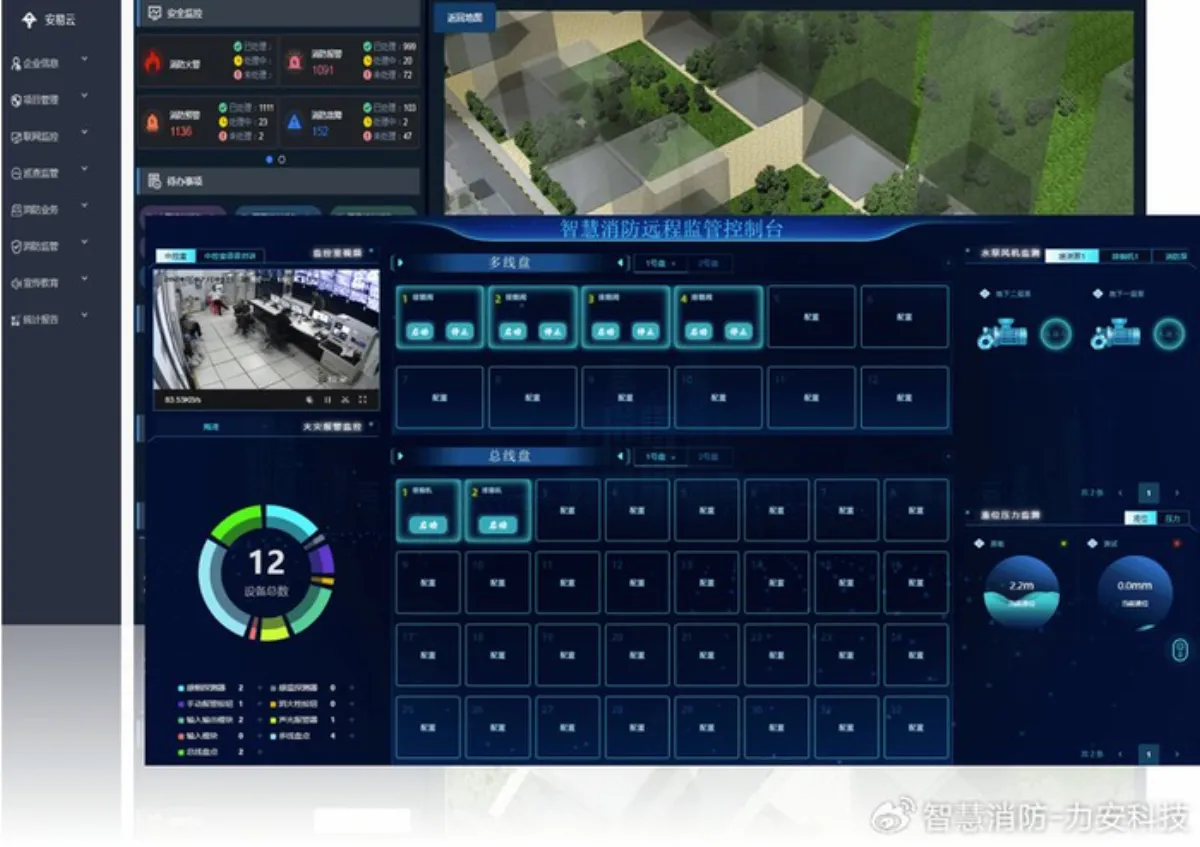
3D building visualization showing exact alarm locations, inspection trajectories, and equipment status
RAG (Red-Amber-Green) status indicators for all fire safety assets — water tank levels, electrical room temperatures, pump pressures
Automated prioritization — abnormal items automatically rise to the top of the monitoring dashboard
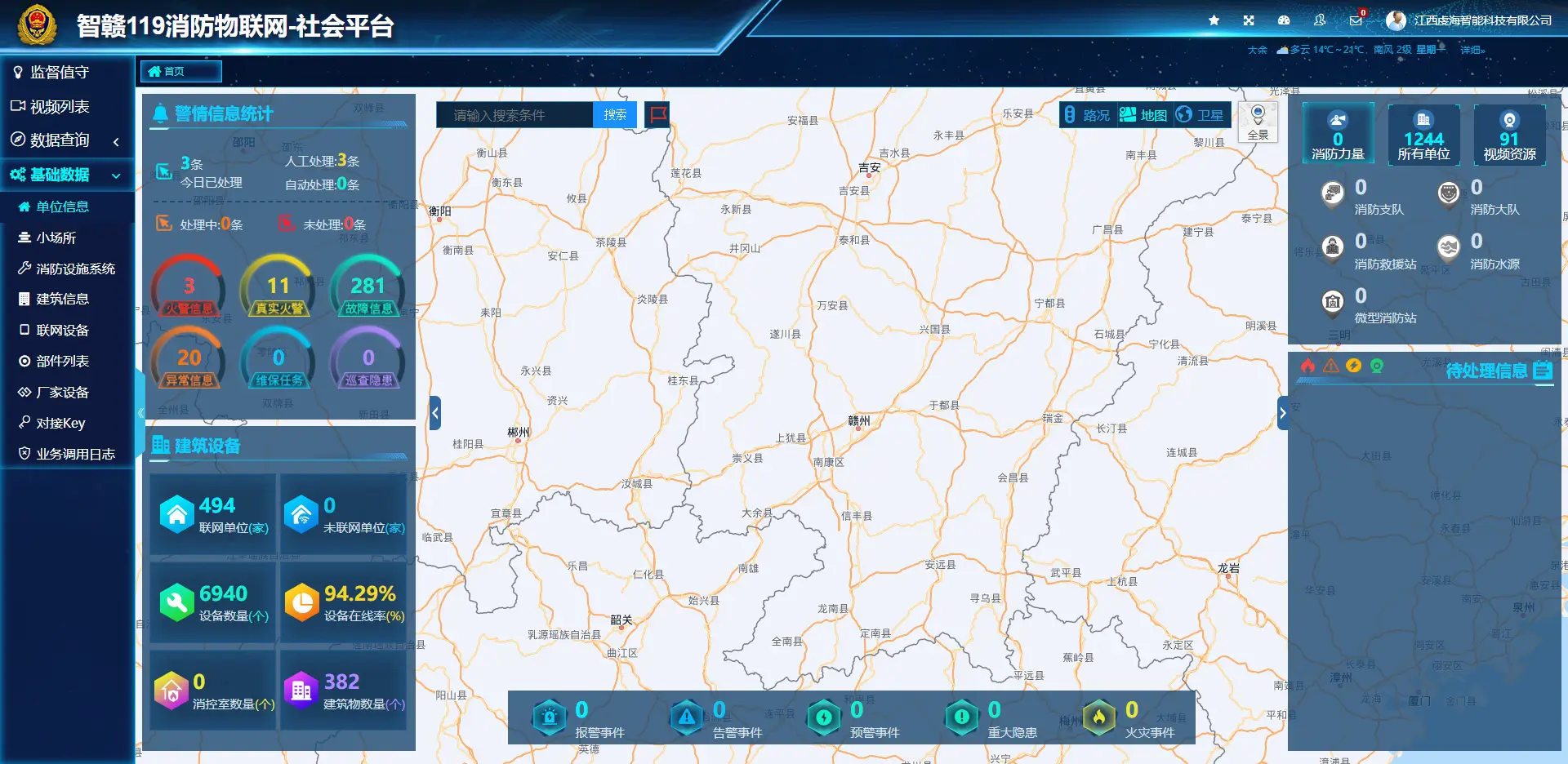
24/7 remote monitoring accessible via command center large screens, desktop, and mobile terminals
3. Dual-Objective Optimization: Safety First, Energy Smart
One of the most innovative features of a smart fire protection platform is the dual-objective optimization model, which operates in two modes:
Normal Mode (Minimum Energy Consumption):
– Intelligently adjusts pump start/stop pressure thresholds based on real-time demand data
– Optimizes non-fire loads (ventilation, lighting in non-occupied zones) in coordination with BMS
– Single pressure-stabilizing pump can save 12,000 kWh/year through optimized scheduling
– Hotel complex energy consumption reduced by 8-12% month-on-month
Fire Mode (Maximum Safety):
– Instantaneously switches to maximum safety upon alarm trigger
– Automatically cuts off non-essential electrical loads
– Prioritizes life safety systems: sprinkler pumps, smoke exhaust, emergency lighting, voice evacuation
– Returns to normal mode only after all-clear confirmation
The Omnifir 131,760 m² case study documented annual energy cost savings exceeding ¥1 million (approximately $140,000 USD) through this dual-objective optimization — while never compromising fire safety.
4. Deployment Options: Greenfield vs Retrofit
Greenfield Installation (New Construction)
For new hotel construction, the smart fire platform is integrated during the design phase:
Full BIM integration from foundation to MEP systems
Sensor layout optimized during architectural design
Edge node placement coordinated with telecom infrastructure
Commissioning as part of overall building systems acceptance testing
Cost premium over conventional system: 15-25%
Typical timeline: 3-6 months for system integration (concurrent with construction)
Retrofit Installation (Existing Hotels)
For existing hotels, the smart platform can be retrofitted with minimal disruption:
Open architecture supports OPC, Modbus, BACnet protocols
Compatible with 50+ fire alarm manufacturers — existing panels can be integrated via intelligent data acquisition modules
No need for complete system replacement — legacy detectors and panels connect through IoT gateways
Installation can be phased by zone (e.g., guest rooms first, then common areas)
Cost savings compared to full rip-and-replace: 40-60%
Typical timeline: 2-4 weeks per zone; 3-6 months for full deployment across a large hotel
Not ideal when: The existing fire alarm system is more than 15 years old and uses proprietary protocols that cannot be bridged. In such cases, partial replacement of the control panel may be necessary before retrofitting.
5. Full-Process Digital Management: From Detection to Resolution
A smart platform digitizes the entire fire safety workflow:
Detection: Sensor identifies anomaly (smoke, heat, water flow, electrical fault)
Verification: AI cross-references with adjacent sensors to confirm (reduces false alarms by 40-60%)
Alert routing: Within 60 seconds, the system routes the alert to the designated contact terminal (front desk, security team, duty manager)
Work order generation: Automatic electronic work order created with location, sensor data, and recommended action
Dispatch: Mobile app notifies nearest available responder; response is tracked via GPS
Resolution logging: Responder documents findings and resolution in the mobile app
Close-out: System automatically logs the event; monthly hazard heat maps guide inspection priorities
This shifts hotel fire safety from “people waiting for alarms” (security staff tethered to the fire control room) to “alarms seeking people” (mobile patrol with handheld terminals).
6. Cost Analysis and ROI
Cost Category
Conventional System
Smart Platform
Savings
Initial equipment
$50,000-80,000
$60,000-100,000
+15-25% upfront
Annual energy (fire systems)
$25,000-40,000
$15,000-25,000
30-40%
Compliance documentation labor
$8,000-12,000
$1,000-2,000
80-90%
False alarm response cost
$5,000-10,000
$3,000-5,000
40-60%
Insurance premium discount
Standard
5-15% reduction
Ongoing
Penalty avoidance
Variable
Prevented
Up to $15,000+
Predictive maintenance
None
30-40% reduction
3-5 year ROI
Payback period: 2-3 years
5-year cumulative savings (200-room property): $180,000-250,000
Decision Engine: If X → Choose Y
If you are building a new hotel (greenfield) → Choose full smart platform deployment with BIM integration. The upfront cost premium (15-25%) is easily offset by energy savings within 2-3 years.
If you have an existing hotel with functioning fire alarm panels → Choose retrofit deployment using IoT bridge modules. No need to replace working equipment.
If your primary concern is compliance and audit readiness → Choose a platform with automated compliance reporting, RAG asset ratings, and real-time health dashboards. Look for built-in regulatory templates.
If your hotel has experienced high false alarm rates → Choose a platform with AI cross-verification and multi-sensor confirmation. This alone can reduce false alarms by 40-60%.
If you manage a hotel chain with 10+ properties → Choose a cloud-based platform with centralized portfolio management. Group-level dashboards and cross-property benchmarking will deliver the fastest ROI.
If your hotel operates in a region with unreliable public internet → Prioritize edge computing capability. The platform must maintain full alarm functionality during network outages.
7. Case Walkthrough: 131,760 m² 5-Star Hotel
& Commercial Complex
Parameter
Value
Total area
131,760.55 m²
Building height
166m (33 floors)
Fire resistance
Grade II
Systems integrated
Water supply, sprinkler, alarm, emergency lighting, smoke control, gas suppression
Deployment
Full greenfield smart platform
The challenge: The hotel-commercial complex combined a 5-star hotel with retail, F&B, and conference facilities — creating diverse fire risk profiles across the same building. 24/7 operations meant that any downtime or false alarm could disrupt guest experience and revenue.
The Omnifir solution:
Distributed sensing network covering all 33 floors with multi-source detectors (smoke, heat, water flow, electrical monitoring, tank levels)
5G + NB-IoT edge layer with local alarm processing — full functionality preserved even during internet outages
BIM digital twin for the entire 131,760 m² complex, accessible via command center and mobile terminals
Dual-objective optimization balancing fire safety with energy efficiency
Full-process digital workflow from detection to work order to resolution logging
Results:
– Energy consumption reduced by 8-12% month-on-month
– Annual energy cost savings exceeded ¥1 million ($140,000+)
– Alarm response time under 60 seconds
– Shift from reactive to proactive safety management
– Mobile patrol replaced fixed-position fire control room monitoring
8. Global Delivery and Quality Assurance
For international hotel projects, especially in remote or developing-market locations, Omnifir’s global delivery framework ensures consistent quality:
Source quality control: All equipment meets international standards (CE/UL compatible), selected to withstand long-haul logistics and challenging local conditions
Export packaging: Professional reinforcement and shock-proof packaging; mandatory fumigation for wooden components to ensure smooth customs clearance
Commissioning and training: On-site system commissioning with local partner training; full documentation in local language
Lifetime support: 7×24 technical response from original project engineers; remote diagnostics and spare parts network
FAQ
Can a smart fire protection platform integrate with my hotel’s existing BMS system?
Can a smart fire protection platform integrate with my hotel’s existing BMS system?
Yes. The platform uses open protocols such as BACnet, Modbus and OPC for seamless integration with existing BMS, HVAC and energy management systems. The dual-objective optimization model specifically requires BMS integration to manage non-fire loads during normal operation.
How does the platform reduce false alarms in hotels?
How does the platform reduce false alarms in hotels?
Through multi-sensor cross-verification (an alarm is only confirmed when two or more sensors agree) and AI-based environmental adaptation that filters transient events like kitchen steam. This reduces false alarms by 40-60% compared to conventional systems.
What happens if the internet connection goes down?
What happens if the internet connection goes down?
The edge layer maintains full alarm functionality. Local processing at edge nodes ensures detection, alert routing and notification continue without interruption. Historical data is cached locally and synced to the cloud when connectivity is restored.
How long does a retrofit installation take for an operating hotel?
How long does a retrofit installation take for an operating hotel?
For a typical 200-room hotel, expect 2-4 weeks per zone. Guest rooms are fastest; common areas and kitchens require more coordination. Total deployment for a mid-size hotel is typically 3-6 months with minimal disruption when phased by zone.
Is the platform compliant with international fire safety standards?
Is the platform compliant with international fire safety standards?
Yes. The system is designed to meet or exceed NFPA 72, NFPA 101, NFPA 13, and local codes including GB 50116. Compliance documentation is automatically generated for audit purposes.
Q1: Can a smart fire protection platform integrate with my hotel’s existing BMS (Building Management System)?
Yes. The Omnifir platform uses open protocols (BACnet, Modbus, OPC) for seamless integration with existing BMS, HVAC, and energy management systems. The dual-objective optimization model specifically requires BMS integration to manage non-fire loads during normal operation.
Q2: How does the platform handle false alarms — a common complaint in hotels?
Through a combination of multi-sensor cross-verification (an alarm is only confirmed when two or more sensors agree) and AI-based environmental adaptation (the system learns normal background conditions and filters out transient events like steam from hotel kitchens or cigarette smoke from designated areas). This reduces false alarms by 40-60% compared to conventional systems.
Q3: What happens if the internet connection goes down?
The edge layer maintains full alarm functionality. Local processing at edge nodes ensures that detection, alert routing, and notification continue without interruption. Historical data is cached locally and synced to the cloud when connectivity is restored.
Q4: Is the platform compliant with international fire safety standards?
Yes. The system is designed to meet or exceed NFPA 72 (Fire Alarm Code), NFPA 101 (Life Safety Code), NFPA 13 (Sprinkler Systems), and local codes including GB 50116 (China) and equivalent international standards. Compliance documentation is automatically generated for audit purposes.
Q5: How long does a retrofit installation take for an operating hotel?
For a typical 200-room hotel, expect 2-4 weeks per zone. Guest rooms are fastest (existing ceiling access); common areas and kitchens require more coordination. Total deployment for a mid-size hotel is typically 3-6 months with minimal disruption when phased by zone.
Q6: What is the expected lifespan of the system?
IoT sensors: 5-7 years (battery-powered) or 10-15 years (wired). Edge gateways: 7-10 years. Cloud platform: continuous updates included in service contract. The overall system lifespan is 15+ years with scheduled sensor replacement, compared to 10-12 years for conventional fire alarm panels.
Omnifir. “Smart Fire Protection Cloud Platform for Large Complexes and 5-Star Hotels” — Case Study. https://omnifir.com/smart-fire-protection-cloud-platform-for-hotels/
Drax Technology. “Hospitality Fire Alarm Systems: Smarter Safety for Seamless Stays.” 2026. https://draxtechnology.com/sectors/hospitality
NFire. “AIoT Fire & Safety Intelligence Platform for Hotels and Resorts.” 2025. https://nfire.in/aiot-fire-safety-intelligence-platform-for-hotels-and-resorts-redefining-guest-protection
National Fire Protection Association. NFPA 72: National Fire Alarm and Signaling Code, 2022 Edition.
National Fire Protection Association. NFPA 101: Life Safety Code, 2024 Edition.
MTech Fire Safety. “Courtyard by Marriott Case Study.” Gulf Fire. https://gulffire.com/courtyard-by-marriott-in-central-asia-chose-mtechs-fire-safety-systems/
GB 50116-2013: Code for Design of Fire Alarm System (China)
Johnson Controls. “Smart Building Fire Safety Integration.” Building Insights, 2025.
Conclusion
A smart fire protection cloud platform represents a step-change in hotel fire safety — from reactive alarm systems to proactive, AI-driven risk management. The Omnifir 131,760 m² case study demonstrates that such platforms not only improve safety outcomes (sub-60-second response, 40-60% false alarm reduction) but also deliver measurable energy savings (8-12% reduction, ¥1M+ annually) through intelligent load optimization. For hotel owners and operators, the 2-3 year payback period makes this an investment in both safety and operational efficiency.
If You Only Remember One Thing
A smart fire protection cloud platform does two things that conventional systems cannot: it detects fires before they start (through continuous AI monitoring of sensor trends) and it optimizes energy consumption while maintaining instant maximum-safety switching during fire events — delivering both safety and cost savings from the same infrastructure investment.
Need a Smart Fire Protection Cloud Platform for Your Hotel?
Get a customized IoT fire monitoring and management solution for your hotel or complex. Our engineers design NFPA and GB-compliant smart fire protection systems with deployment worldwide.
Three Things to Know – Heavy industry fire protection in remote, resource-limited locations demands a fundamentally different approach — adapt international standards to local site conditions rather than force-fitting a developed-market design. – Modular, prefabricated…
Why Gas Suppression Is the Standard for Data Centers Water-based sprinklers are the default fire protection for most buildings. For data centers, they are the last thing you want. A sprinkler discharge can destroy servers,…
Why Choosing the Right Fire Suppression System Matters Choosing the wrong type for your environment can mean equipment damage, regulatory fines, or worse — system failure during an actual fire. Each system type is engineered…
Cold Storage Fire Protection at -38°C: Engineering & Compliance Guide Key Takeaways Standard wet-pipe sprinkler systems fail at sub-zero temperatures because water freezes in pipes, causing blockages and burst lines Dry-pipe and pre-action sprinkler systems…
Key Takeaways 1. What Is a Kitchen Hood Fire Suppression System? A kitchen hood fire suppression system is a pre-engineered, automatically activated fire extinguishing system built into a commercial kitchen’s exhaust hood, ductwork, and cooking…
Key Takeaways Hotel fire safety compliance requires coordination across at least seven NFPA codes or their GB equivalents — this guide consolidates them into a single actionable checklist. The most common violations in hotel properties…
To provide the best experiences, we use technologies like cookies to store and/or access device information. Consenting to these technologies will allow us to process data such as browsing behavior or unique IDs on this site. Not consenting or withdrawing consent, may adversely affect certain features and functions.
Functional
Always active
The technical storage or access is strictly necessary for the legitimate purpose of enabling the use of a specific service explicitly requested by the subscriber or user, or for the sole purpose of carrying out the transmission of a communication over an electronic communications network.
Preferences
The technical storage or access is necessary for the legitimate purpose of storing preferences that are not requested by the subscriber or user.
Statistics
The technical storage or access that is used exclusively for statistical purposes.The technical storage or access that is used exclusively for anonymous statistical purposes. Without a subpoena, voluntary compliance on the part of your Internet Service Provider, or additional records from a third party, information stored or retrieved for this purpose alone cannot usually be used to identify you.
Marketing
The technical storage or access is required to create user profiles to send advertising, or to track the user on a website or across several websites for similar marketing purposes.